

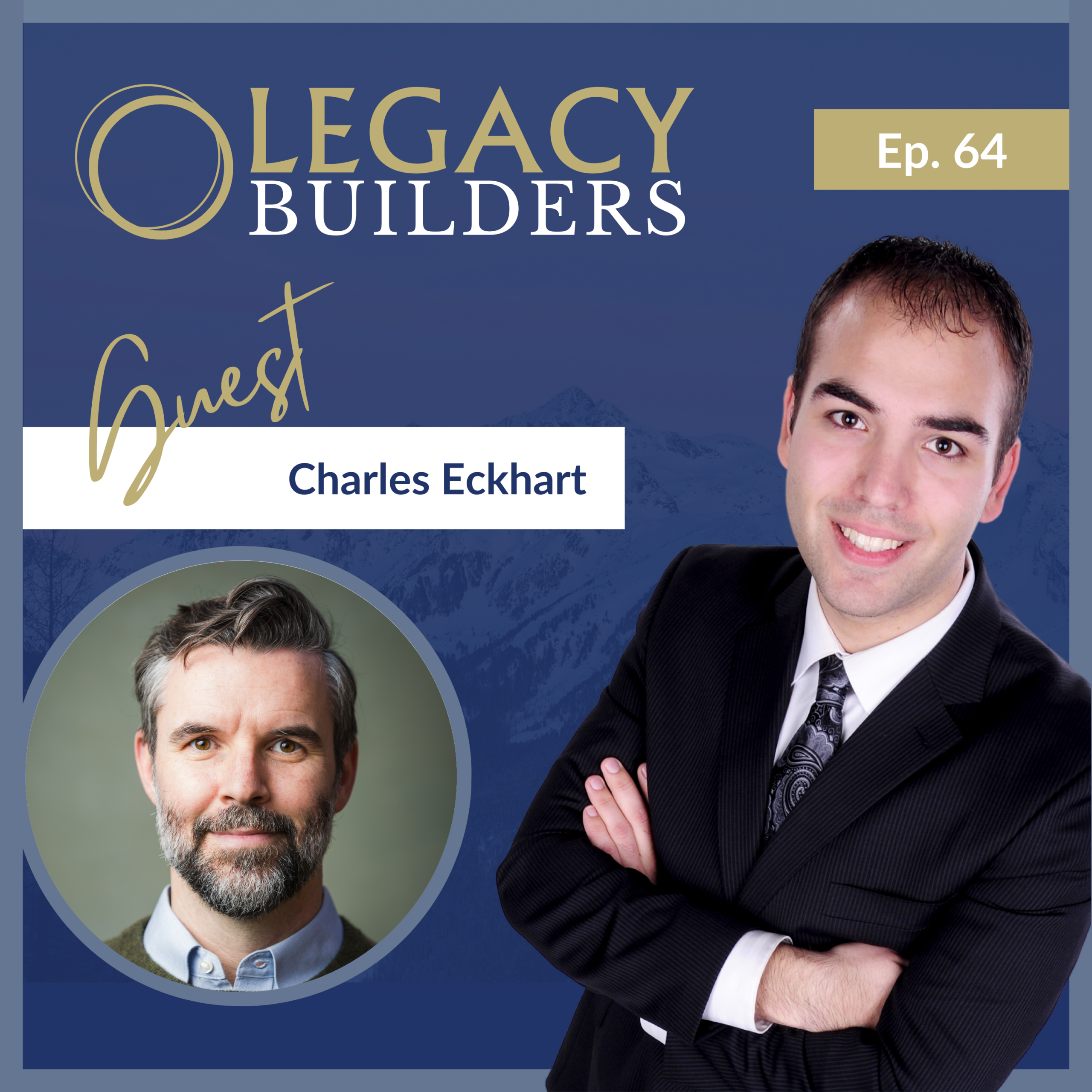
Steady Through Uncertainty: Mentors, Mistakes, and Next-Gen Growth
LISTEN ON YOUR FAVOURITE PLATFORM
In this episode, we welcome Dr. Charles Eckhart, Founder and Managing Partner of Cathexis Group, a family engagement and governance consulting firm based in Santa Barbara, California. Charles advises enterprising families and couples of significant wealth through major transitions, helping them strengthen family governance and build collaborative decision-making practices that endure across generations. He also works closely with financial institutions to train and support advisors in navigating family dynamics with greater clarity and confidence. Drawing on his background as a clinical psychologist and academic instructor, Charles brings a thoughtful, grounded perspective to the intersection of family wealth, legacy, governance, and relationships. Our conversation centres on how families can prepare the rising generation not just to inherit resources but to develop the resilience and judgment required to steward them well.
With a posture of curiosity, we explore how meaningful growth often comes through “earned” experiences and how families can model vulnerability, responsibility, and even mistakes in ways that strengthen confidence rather than diminish it. Together, we consider how intentional culture-building can help families move from overprotection to purposeful preparation, supporting capable next-generation leaders with both strength and humility.
About Charles Eckhart
Dr. Charles Eckhart is the founder and managing partner of Cathexis Group, a family engagement and governance consulting firm based in Santa Barbara, California. He works with families and couples of significant wealth to support family transitions and build governance practices that strengthen collaborative decision-making and long-term alignment. He also partners with financial institutions to train and support wealth advisors in family dynamics and governance.
Before founding Cathexis Group, Charles built his career as a clinical psychologist, including academic teaching and training roles in doctoral clinical training programs. He contributes publications, presentations, and thought leadership at the intersection of family wealth, legacy, governance, and relationships.
Resources discussed in this episode:
- Thinking, Fast and Slow
- Purposeful Planning Institute
- Family Wealth Alliance
- Wilfred Bion
- Carl Jung – Transcendent Function
- Søren Kierkegaard
Contact Cory Gagnon | Beacon Family Office at CI Assante Wealth Management Ltd.
- Website: BeaconFamilyOffice.com
- LinkedIn: Cory Gagnon
- LinkedIn: Beacon Family Office
- Email: beaconfamilyoffice@assante.com
Contact Charles Eckhart | Cathexis Group
- Website: cathexis-group.com
- LinkedIn: Charles Eckhart
- Email: charles@cathexis-group.com
We’re bringing together leading experts to tackle some of the most pressing challenges facing family businesses today from succession planning and governance structures to preparing the next generation for leadership roles. You’ll walk away with actionable strategies and fresh perspectives on building resilient family enterprises.
Haven’t caught one of our webcasts yet? No problem. All previous sessions are archived and ready to stream whenever you’re ready to dive in. Simply head over to legacybuilderswebcast.com to register for our upcoming session or explore our growing library of past
Welcome to Legacy Builders, strategies for building successful family enterprises. Brought to you by Beacon Family Office at CI Assante Wealth Management Limited. I’m your host, Cory Gagnon, Senior Wealth Advisor. And on this show, we explore global ideas, concepts, and models that help family enterprises better navigate the complexities of family wealth.
Today, we welcome Charles Eckhart, founder and managing partner of Cathexis Group, a family engagement and governance consulting firm based in Santa Barbara, California. Charles advises enterprising families and couples of significant wealth through major transitions, helping them strengthen family governance and collaborative decision-making. He also works with financial institutions to train and support advisors in family dynamics and governance. Before founding Cathexis Group, Charles was a clinical psychologist with academic teaching and training roles, and he continues to publish and speak on the intersection of family wealth, legacy, governance, and relationships.
My goal is to be the most curious person in today’s conversation with Charles, as we explore how families can help the rising generation build real preparedness and resilience, especially when resources can unintentionally soften the very challenges that develop strength. We talk about “earned” experiences, the power of modeling vulnerability and mistakes, and how families can support next-gen members through uncertainty without stepping in too quickly. Together, we look at how culture and the stories families tell shape confidence, decision-making, and legacy over time.
Now, let’s dive in!
Cory: Welcome, Charles. We’re excited to have you here today to share your wealth of knowledge and experiences with us. Let’s dive in, shall we?
Charles: Yes, please.
Cory: Imagine you’re delivering the commencement speech to the graduating class of 2026, and you have the chance to inspire them with your story. How would you begin your speech to convey the incredible lessons and expertise that you’ve gained along your career?
Charles: What’s fun about a commencement speech is that students find themselves in a place that we all find ourselves throughout life, which is a strange intersection between an ending of something, and the feeling of triumph and pride that comes along with it, and sometimes the terrifying reality that whatever the next thing is has not yet begun.
And it’s quite a balance to hold the two of them. Keeping in mind that when you look back on the last four years, you went from being likely someone leaving high school, an adolescent moving into adulthood, and you went out and you lived on your own in a lot of ways or pseudo on your own, and you had room to fall and fail. And if you’re here and taking your certificate, you didn’t. You made it through. And there’s much to be proud of. You probably grew up a lot, got to know yourself, had a good time, and got a great education.
And when you look out at adult life, it might seem like you’re entirely starting over again.
And the tension between those two things can be quite a challenge. I think getting good at that, the tension between opposites. Carl Jung had this idea that, I think he called it the transcendent function, which occurs when we’re able to contain the tension between two opposing forces, that is fundamentally transformational.
And through my adult life, though I hope I get a lot more of it, there are continued opportunities over and over again to have to hold, the excitement of a growing success and tolerate the disappointment and letdown when it doesn’t come through, or grow into a new role at the family business, or a company, or in one’s career, that includes the requirement that you tolerate not being good at something.
The tension between I did everything I could to get to this place and built competency and capability and experience, and also in this next step of transition. I have no idea what I’m doing, and I’m terrified everybody’s going to find out. So I think that a message that I keep close to myself with mentorees, students, people I’ve supervised, and people who’ve worked under me, my attitude is always being patient with yourself, understanding that when things feel really difficult and impossible, keep trudging. You’ll get to the other side of this. And on the other side, when things feel really easy, and it feels like you’re really good at something, keep trudging. You’ll get to the other side of this.
I hope you don’t keep feeling excellent at something, because what a disappointment if at 22 or 32 or 52, you’ve actually arrived. I think that’s kind of deadening. I think the opportunity for growth, transformation, disappointment, and the experience of surprising oneself is what life’s all about. A lot of my own story includes, and we can dig into it as our conversation evolves, a lot of my story includes the continued reinvention of myself. I think it’s something I’ve gotten good at. It has always felt like some weird mixture of both a failure and a big success.
And so, I had to hold the tension between the two. But being able to reinvent oneself, I think, is an incredible opportunity and privilege. I think it works like this. If you can, whatever stage of life you’re in, if you are starting a new career, or if you’ve just finished college, or if you have just taken a position on the family council, or if you have just taken a more significant leadership position in a family enterprise, expecting to reinvent yourself, expecting to be different in a way that you won’t know what it looks like until later is protective. Setting out to build competencies over time, not to prove, I see so often, especially in the rising generation, especially in people 40, this drive to prove oneself.
I encourage people to settle into the idea that, more importantly, take time to become competent at things. And not competent like you are excellent and always excellent, but competent like you’ve built real muscle in this area of expertise or these skill sets, you’ve become real comfortable with them. You’ve tested them. You’ve failed at them. You’ve bombed in a lot of different ways. You’ve succeeded in a lot of different ways that you didn’t expect. That kind of deep competence, build that in certain areas. Build that in the necessary areas that’ll help you grow.
And as you continue on growing and maintaining, I think necessary failures are really useful because they help us become more durable and humble. We can maintain curiosity through that and build these competencies and expect to reinvent ourselves. When the catalytic moment strikes, you’ll have a chance to, because life’s always in transition.
And I like this idea. I forgot who it is. Might be Kierkegaard. That we live life forward and we understand it in reverse. A lot of my life has not made sense at the time. And now at my age into my forties, I can look back, and I’m not a deep believer in fate. I think it’s a provocative idea that sometimes can add meaning to things. But when I now look back at the last twenty years, my adult life makes a lot of sense because I was doing the best I could following things that I was curious about, and that I was hungry to get up and do during the day.
And over time, as I got to know myself better and as I built competencies in areas, I’ve grown to be a person who’s really comfortable with reinvention. And if I could gift that to the next generation, had I been able to gift it to myself, I think I’d have been a lot more comfortable in periods of not knowing. Things get foggy. I live in Santa Barbara. And in Santa Barbara, we get a lot of coastal fog. I live about a mile from the water. And sometimes there’s a big wall of fog coming from the water that envelops us. And other times, depending on the way the pressure systems are working, as I look up at the mountains opposite the water, the mountains will be covered in fog, and the water will be open. And other times, we’re enveloped by all of it. When we’re enveloped by all of it, it can sometimes lift suddenly, and over the water it’s entirely foggy, or over the mountains it is, but then we’ll get this patch of sun. And a lot of the time, we’re simply waiting for it to open. It gets warmer. We can see what’s around us. I think life is very much like this.
So as we get deeper into our adulthood, the rising generation, building competency, comfort with appropriate failure to build durability over time, comfort with reinvention, and the humility necessary to keep going, I think, really sets people up for success. That’s what I’d say.
Cory: Charles, I’m envisioning, and actually, that feeling of being in fog tends to be cold, when you talked about the sun and the warming, of what that metaphor can mean as people look at their next chapter. And so as you think of that feeling of “I feel cold and alone and and really can’t see much around me,” how do you envision that space and becoming more comfortable within that space?
Charles: I think the more time it happens in my life, the more comfortable I am with it. Having mentors has been really helpful to be able to go and say, I am in the fog. I don’t have any idea, up from down. I’m walking. I don’t have a clue if I’m in the right direction. An older person who’s been in the same scenario over and over again kind of chuckles and says, this is going to be fine. Keep going. What you don’t do is dig a hole and hide in it. Keep moving, and you’re going to find the trail.
And if you run into fellow travelers along the way, grab onto them. So if you’re a member of the rising generation, I think it’s probably good to be part of a network of other rising gen members. It doesn’t matter the variety of operating companies that you come from. It doesn’t matter the size of the wealth, or the real specifics about the dynamics in your family or or the history, you’re a G3 or if you’re a G8. If there is enough similarity for you to find some shared experience and language and a little bit of difference, it’ll help you locate yourself.
So I think grabbing on to fellow travelers as best you can, hearing where they have gone, what have you tried, to the north, is there a path, is there not, is there water to the south, is there not, mentors to encourage you along the way, and just time.
Cory: And, Charles, thinking of starting over and preparation for the next thing, sometimes these rising gen members are in this circle of continuing to prepare for something, and circumstances or decisions have allowed it to be safe and maybe not take those skills to the next level and implement. And so how can we balance being a lifelong learner and a student of our trade, with actually having practice in some of those tough situations?
Charles: I love that. I see a lot of that in which the great advantage of having resources and opportunities that are passed down over generations is that there are some difficulties that can be taken off the plate. And that’s good. The big liability in having resources and opportunities passed over generations is that there are some difficulties that can be taken off the plate. And a lot of those difficulties are necessary for us. The way we all get stronger.
I like exercising a lot. I didn’t do as much in my twenties. As a kid, I grew up playing soccer, but very competitively, I had some injuries and spun out in high school. And then in my thirties and forties, I sort of really rediscovered exercise. And the beauty of exercise is, whether I’m doing some kind of cardiovascular activity or I’m strength-training, we do harder things, and we get stronger. Our muscles tear in small ways, and they rebuild themselves and stitch the fibers together. And the connective tissue expands and becomes more complex to support these tissues. And that happens over and over and over again, and we become more capable and more durable and stronger as a result. Difficulty is a necessary ingredient for growth.
If a listener is a wealth leader or wealth creator and thinking about how do I raise and support ambitious children with the opportunities that we can afford them, my business partner and I do a lot of work with with families in this scenario and give talks to multifamily offices and private banks and others about supporting an an ambitious, capable, authentic, and and internally driven next generation. I think it is necessary for them to have essential experiences that are progressive in nature that allow them to fail, and that it be in the culture of the family.
There are all kinds of dangerous things about legacy, and maybe this is what I end up jamming about today. One of the difficulties with legacy is when it is entirely backwards-looking. Legacy as a stereotype, being grandpa did this thing, and was very significant. And there’s a statue in town, and there’s money, and there’s an operating company, and there’s a family office or whatever it may be.
Cory: Name on the building.
Charles: The name. There are names everywhere. And that way, when I go to college, somebody thinks to themselves, well, did you get into college because you deserve to be in college, or did you get into college because grandpa bought the building? And therein lies the burden of the next generation. Doesn’t mean your name shouldn’t be on a building, but I think that there are all kinds of thinking about, and then framing around what we do as a family, what this means to us, how we think about the legacy, and how hopefully legacy should snowball.
My hope is that my children are much better off, and I don’t just mean financially, I mean way more than financially, than I am. My investment in my own children is so that hopefully they aren’t boneheads in the ways that I’ve been a bonehead. If I can help them sort through life in such a way and frame things up from the beginning that they’re growing and becoming, they’re always in transition. They’re always in a process of becoming, and becoming requires challenge and difficulty.
One of the impossibilities therein lies in these families, a lot of those challenges and difficulties are artificial and have to be created. And I see families all the time with very well-intended, loving, thoughtful, very bright, successful families that have not the best instincts in how to create those artificial challenges. Because how does one do so if someone came from a middle-class family and built something really significant, lightning struck, and they were remarkable in ways, eccentric, took risks, and bet on themselves and the enterprise, and it worked and everything came together. The experiences they had came from a place of necessity or closer to necessity than those that will come for their children. And figuring out how to do that over time to help the rising generation become adaptive, become agile, become durable, and get to know themselves, is quite a difficulty. And I think much of it has to do with the culture of the family. Do we idealize the founder, or do we have a human perspective of them? There’s much to admire about their story.
Almost every entrepreneur I’ve ever met also has incredible endurance, and they keep going. They take it in the face. They lose a most important client. It was a bomb. Over and over again, you see these things that just didn’t work. They weren’t great ideas. They thought they were, and it didn’t work. And when we are backwards looking about legacy, and look back and only frame up all of the successes and the grandness of what occurred, we shortchange the next generation, because we’ve sucked the humanity out of the story. So family mythology in history that’s passed down over time that gives real, human, and dignified descriptions of our ancestors, sets the next generation up to see themselves similarly.
So I like this idea of legacy that snowballs, or of foresight legacy in addition to the backwards-looking, to create some more balance. I’ll oftentimes say to families that thinking about the rising generation really is we’re working like angel investors. If you’re going to buy something and invest in something when it’s small, buy a portion of a company when it’s small because you can see the future possibilities. It’s not one linear path. You probably see a spread of possibilities. And if you can then hold on for a long period of time, encourage the angel investment, sit on the board, mentor leadership and help them, and then allow them over time to make the necessary mistakes for them to build their capacity, their good judgment, their accumulated experiences over time.
The CEO that went through the great financial crisis, we’re now at a time where that was seventeen years ago or something like that, eighteen years ago. We’re now at a time where some of those leaders are starting to retire, and those are essential experiences to be able to be passed on. I think the same thing in families. So the extent to which we can pass on some of our challenges, give real and authentic descriptions of what our life has been like to our children, and then empower them to go through the same thing. Help set them up for progressive, necessary experiences to build their confidence, this is what I really want for the families I work with on my own.
Cory: I really appreciate that angel investor. Thinking about being an active investor. And you can’t be passive. You can’t delegate your responsibility here. And so, Charles, when you think about those, artificially-created experiences, what are some of those examples that you can think of where somebody really did it well? And maybe we can contrast that with, where you see families struggling to create those experiences of struggle, and they haven’t done so very well artificially.
Charles: You didn’t tell me you were going to ask me that. I love it! So I have this friend named Frank Foster. Forgive me, Frank. I didn’t tell you I was going to call you out on podcast. I won’t tell you that I recorded this podcast. Maybe Frank won’t find out. Frank’s wonderful. And Frank is a leader of a family and a number of associated businesses included. And Frank has been working on this idea of Mattering. And with the idea being Mattering with a capital M, Frank’s idea, to the extent that we can communicate to the next generation that they really matter to us. And not just that we love them, but that actually our family is strengthened through its diversity of personality and experience, that we are a multidisciplinary entity as a result of you guys, the next generation. And we have so much to learn from you.
Additionally, you’re going to make thousands of decisions when we’re gone, and we want to support you in passing along all the possible wisdom that we can, and allowing you to learn to fly the plane because we need you to. And this is going to be way better in the future than it is now if we do this all right.
I generally like the idea of family members from family enterprises going out and getting experience in the world outside of the family. Now I think there’s interesting pushback. Frank has had some with me, which is what better place for our future leaders to get educated than with us? If we have a large enough family with a diversified enough set of skills, personalities, and leadership roles that we can really embed the next generation and give them exposure to a range of experiences and capabilities across the family.
The reason I like people getting experience outside of the family, now that could be college, that could be starting their own, small side business in high school or in college or in their twenties. It could be, going on a Knowles trip. It could be some significant travel. It could be deep involvement in a philanthropic opportunity in which they can really focus in on.
I took a gap year from 18 to 19, and I went to a place away from home. And I didn’t buy a big giant beautiful home, didn’t have a housekeeper, didn’t have all the things that made my life tick earlier that I may have grown up with. And I went and got embedded in something and wholly enveloped in it to build my experience. The folks that were there that I worked for, they didn’t care who I was or where I was coming from. They did not allow me all kinds of excessive exceptions to things. I had to figure out how to go at it and fall and get back up.
Early career that’s outside of the family enterprise. It can be somebody going to law school or medical school. It can be someone working for a large institution to get a sense for how that works, how decisions are made. It can be going to work for another investor. I love the idea, and a lot of families that we’ve worked with, I’ve encouraged, and we’ve seen it work really well where you guys have a huge network. If you have a 21-year-old, call some of your friends and invite them to send their children to you for summer internship and take excellent care of them and send them yours. And be real with their kids. Promise them that you will, and encourage them to do the same so that people can get experience outside of the circle.
My children are on the swim team. My dad was a very competitive division one collegiate swimmer, and I cannot drown, but I’m a terrible swimmer. I have a body like a corgi. I’m all torso, very short legs and arms, and I was not built to be a swimmer. And I grew up with a dad who was excellent at it. And so it wasn’t my thing. My children have taken it up. And one of the things that I love about swimming is that in Santa Barbara, it never gets that cold, but swim is year-round. My son’s getting in the pool at 7 AM on Saturday morning and doing two and a half hours of swim, when it’s raining, when it’s cold, when it’s uncomfortable, when it’s hot. Hot’s nice. You jump in the pool. It’s cozy. Cold, it’s kind of brutal. And we haven’t been punitive about it, but my children are very good in a lot of ways at being uncomfortable as a result of four days a week, going and being uncomfortable, and learning that they can tolerate discomfort in the right way. And when they come home, we take a hot shower, we put a fire on, we feed them warm soup, and everything’s great. And they get a bunch of endorphins.
Sometimes these experiences are very simple that people can have. What is it like to try really hard to get that time that you want to get and you just don’t. And so you don’t move up to the next slot, unfortunately. Can we go to practice next time and continue building and knowing that sometimes it doesn’t work out the way we wanted to. And we tried really hard. We deserved it. Didn’t work because that’s how life is. These kinds of experiences can happen in so many different ways, and I think that it is probably a little different, one kid to another, a little different from one family to another. Why do we shovel our driveway in Canada instead of when we could hire somebody else to do it?
I think what doesn’t work is when the next generation is encouraged to stay comfortable their whole lives, and when maybe parents are not around because they’re really busy, or there are all kinds of different reasons why the quick decision, the fast food decision just may be disrespectful. I’ve made plenty of fast food decisions. but the fast food decision of, okay, you don’t like it, you don’t have to do it. Or, okay, you can work on your homework later on. You can play games now. These kinds of decisions are more difficult for parents because they have to uphold it, and they have to say, we agreed to this, that you would do this. I know you don’t want to do it, and this is what we do in our family: we follow through with things unless there are really unusual circumstances.
So, of course, we’re going to swim. Of course, I’m getting my ride this morning. I don’t feel like it. I’m tired. I don’t want to go get on the bike. I’m going to go get on the bike. Not so restrictive, but most of the time. So when the opportunity for pleasure and avoidance of pain has been a central organizing principle in a family.
One of the strange things to me about wealth that can start to look kind of psychotic is, as resources grow and power and influence grows, the opportunity to avoid pain becomes more and more possible. And unfortunately, I’ve seen over and over again, families develop an incredible weakness and lack of durability when it comes to struggle and challenge, because they haven’t had the necessary experiences all along the way to accumulate it. So when families emphasize pleasure, having, buying, avoiding, having the staff do it, not cooking. But fine, have a chef, I don’t care. Have them some of the days chop the vegetables. Don’t cook it. And on Sundays, chop it yourself and cook it, and have your kids experience a meal that is not cooked from the chef that used to be at so and so. Because it gives perspective.
I like athletics for these reasons. I like academic endeavors for these reasons. Chess is wonderful because you lose all the time. Board games are wonderful because you lose. And those folks, when we don’t get good at that, it’s quite a challenge later on because eventually life catches up. If you cannot endure a dinner at a restaurant that doesn’t have your favorite kind of chocolate cake and it needs to be brought in, it’s a problem. Of course, you can afford to have dinner wherever you’d like and have chocolate cake. And if your children grow up watching you never make do with anything less than exactly what you want, you’re going to have children that can never make do with anything less than exactly what they want. And life will kick their ass. It will feel bad to them, and it will likely feel bad to the parents as well.
I don’t want to send people out to be sadistic with their kids, for god’s sakes, but a reasonable balance between striving, struggle, necessary failures that are accepted as part of life and how we become ourselves, and pleasure, experience, enjoyment, connection, support, help. When I picked my daughter up from school yesterday, she’s 11, I carried her backpack for her. Why? Because she’d carried it all day. I don’t have somebody carry her backpack for her all day. But when I see her, and I walk to the car after picking her up, I’m happy to do that kind of thing.
It’s all about rightsizing it. And I think as we scale that through life, I mean, had we all day, I’d be happy to talk about what that looks like in my mind for young adults and for middle-aged adults. But I’m trying to give examples of how to think in this sort of progressive way that helps us build durability, competence, comfort with the turbulence of day-to-day life, because we can’t escape it. We die at the end of this. And we die in most cases when we’re old and frail. We don’t die when we’re strong. Some people do, unfortunately. But at the end of this, we are vulnerable. And so I think humbly becoming comfortable with vulnerability, depending on others in the right kind of way, accepting that we can’t get everything just right, and trying really hard is the right direction.
Cory: Charles, before we wrap up, I’m really struck by the concept of mattering, and maybe looping these together, of you matter, we love you, and we do hard things as a, and so those three things in mind, what would, from your perspective, because everyone needs to find their way. But having that conversation, thinking about your kids, and I’m sure you’ve had this conversation, and I’m not asking you to, to give us how you’ve communicated. But what might that conversation look like if we had, you know, maybe the kids are in those early teens, and we’re saying, some of these experiences are maybe we just haven’t done this right. And now I’ve listened to Charles for the last half an hour. I’m thinking, how do I have this conversation with my kids to make sure they still know that they’re loved? We’re really going to show them that they matter, and we need to create more opportunities for them to get that endorphin rush of doing hard things.
Charles: Well, I think first off, my message, certainly to myself, and to everybody else, is that, unless it’s an egregious mistake, those things can be repaired and reinvented. And so if you’re hearing this stuff and going, I haven’t done this, great. I’m certain I’m wrong in all kinds of ways in your own family. You’ve got to sort of navigate this in, you’ve steered in a way that makes sense in your own family.
I will often say to my kids, you guys, I am making mistakes constantly every day. Well, life, in my view, is an ongoing experience of hopefully making smaller and smaller mistakes, but it’s important that we get good at repairing those mistakes that we make. I think it’s much better to be good at repairing mistakes and ruptures than it is at not making them. Good to try and not make them, but it’s inevitable that we do.
I think listening to your children, whatever the age they are, be they 12, 17, 31, about what really matters to them, what they’re interested in, what they’re struggling with, what is unknown to them, and giving that room to just be how it is. Hear them deeply and take it into your heart, and think of them in this way. This is what’s happening for them. Listen better as best we can and then check and see. Did I understand that right? I didn’t really realize this, or I’ve heard you say this, but I think I heard it a little bit more deeply this time. And then model it. The ambitious, eccentric wealth creators that I often do a lot of work with, sort of G1, G2 transitions. I have the great privilege of working with all the families that I work with, and the great privilege of working with families that are further along, G3, 4, 5, 6, and probably a small majority of the families we serve are G1, G2 transitions.
When we work with wealth creators in how to think about their children, and supporting their children in creating their own path forward, given the complexity of their future, I’ll often encourage them to model and come home, and tell them about some of the mistakes that they’ve made, especially the not sexy ones. Not just the, hey, I bought this company. I thought it was great. It turned out to not be. That’s important. But also, you guys, I forgot an appointment today. I had a meeting with somebody that was really important to me. It was a mentoree, or it was a colleague, or it was somebody I look up to, or whatever it is. I was ten minutes late because I didn’t plan, and I was humiliated when I walked in. Give them some of the nasty stuff.
Or I lost my patience at work in a way that’s just unacceptable. And I’m better than this, and I wasn’t today. And I thought about it a lot, and I don’t understand why I did it. Or I thought about it a lot, and then I realized it’s because of this. It’s because I had this expectation, or it’s because I was upset about something else, or I was distracted about something else, or I was mad about something that had happened, and it just came out at work with my partner or whatever it was.
Model some of these things so that your children can have a more human view of you. And to the extent that they already see you in an idealized nature. To the extent that they can hear from their parents, that these things occur and that it is a normal part of life, and we’re not better than it, the easier it’ll become for them to do so. Why did you have a b plus in this class? What’s going on? You got a 98, 97, 94 on these tests, and then there’s this huge zero on these two homework assignments. What happened? My god, I’m so embarrassed, I lost them entirely. I don’t have a clue where they are. Okay. And you know what? This stuff happens. This is an important learning lesson. Let’s figure out what’s going on. We’ll adapt from this.
It makes it possible to come home and say that I’ve missed this deadline. Or I’m not prepared for this thing, and I need two weeks. I only have one. Can you help me? I want my children to be able to say that. I suspect you do too. People may think, well, I want children that don’t do that. Well, that’s good. Aim for that. Of course. We all do. And let’s get real about ourselves, that we make mistakes, that often we hide from ourselves and others to the extent that you can share some of them appropriately on the right timeline. Modeling is a huge benefit in families, because then your kids watch you grow through it.
Cory: Charles, as we near the end of our conversation today, there are a few questions that I ask each guest before we wrap up. Are you ready for the tough ones?
Charles: Yes. Come on.
Cory: Alright, what is one key strategy that you believe is most important for building a successful family enterprise?
Charles: I think everybody in the family has something to offer, and it may not be obvious at first, especially if you’re thinking about the black sheep. Those of us who have been black sheep in the past know that there was something to be offered. Sometimes the black sheep is the person who is the truth-teller about the very uncomfortable truth. Sometimes the black sheep is the one who is sensitive enough to respond to the great pressure in the family. And maybe they crack first, and it looks ugly because they developed a substance issue or they went and lived in an ashram, or whatever they decided, whatever happened. But carrying the idea that everyone has something to offer gives us the agility to find a role for everyone. If everyone belongs, everyone has something to offer. When we look at the next generation, knowing that is the case, it’s just a matter of finding what that is and allowing them to settle into it.
Not everybody should work in the operating company. Not because they’re not as smart. Not because they’re not as good. Because it doesn’t suit them. That person is the one who might throw the biggest party. That person is the one who is quiet and has a very sensitive ear and has the closest relationship with the next generation. Or maybe that is the one who has the exceptionally open heart that really starts to lead the philanthropic wing of the family, or that brings the soul of the family to dinner. And when Thanksgiving happens, or when a holiday party happens, or Shabbat happens, that person is the one who really is focused on what’s happening there so that dinner becomes a family meal, in a gathering.
There are all kinds of contributions that people can make. Find a way to learn from other family members. This person is so good with dogs. And maybe this is the only place that we touch. And, look, I’m just not as good. And so I’m going to call them up and say, Look, I don’t understand what’s going on with my dog. Can you help me understand? The intangible closeness and connection that comes as a result can really deeply compound in families. And I think when a family culture and family mythology hold this viewpoint, it is significant. You can feel it. So I’d say that.
Cory: I love that. I think of appreciation. And if we appreciate something, it appreciates. And so that’s what keeps the mind is.
Charles: I love that. I’ve never heard that play on words. I like that a ton. A lot of times, people are afraid, you know, this person has such a loud voice in the family. If I ask them what they think about this, they’re going to feel like they can take it over. And there are oftentimes a lot of small tactical workarounds with that, that is, beyond the scope of what I’ll fill the air with today. But calling up whoever that may be, waiting for the opportunity to be able to call them up and say, look, I have this thing going on in my life, and I know you’ve had a similar thing, or you and I think in different ways. And I figured calling you, if you do me the favor of giving me some of your thoughts about it, might really help me think differently about it. Can I run this by you?
Doesn’t mean you have to do what they’re going to say. It doesn’t mean that you’ve just offered them some significant opportunity to grab control or anything like that. You’re humbly asking for their viewpoint on something. It could be simple, look, I can’t figure out which gutters I want to put in the house, and you have a design eye better than I do. Or, I remember that you went through this challenge. Is there anything from your experience that you could help me learn from so that I can navigate this better, or whatever it may be. Asking humbly for some of those things invites people into conversation and a relationship in a new way. That’s, I think, the outcome.
Cory: Amazing! Charles, what is the most common challenge that you see family enterprises encountering when it comes to wealth transition and generational continuity?
Charles: I think, misunderstanding. Unexplored misunderstanding. Look, he’s this way. He’s always been this way. I’m his mother or his father. I know exactly how he is. Could in some ways, be right. And in other ways, I hope you’re wrong. Because if you know exactly who your child is at 18 and they’re going to be exactly the same in their fifties, well, I don’t know. I’ve never met that person. I think unexplored misunderstanding is a grave risk in families and is rampant. I think if you drill down deep enough, it’s in every family. Just perhaps at a different size and scale.
If you believe that you know someone’s viewpoint on something before asking them, test it. Go and ask them. And say something like, can you tell me where I’m wrong? I saw there’s this thing happening, and we’re going to sell off an asset. And I’m imagining your viewpoint is this. I wrong in any area with that? Or, we’re hiring a new trustee, and I’m imagining that your preferences will be the following. What am I missing, or what do I have wrong? And go and test it, and you’ll be able to add texture and gradient to your viewpoint of them.
And you might catch up to the opportunity, or you might have the opportunity to catch up to the reality that you’re incorrect, that this person is in their own process of becoming. Are you exactly the same person you were twenty years ago? I bet not. Has your viewpoint evolved over the last year? Probably. Hopefully. And so affording the same opportunity to your family members and people that may be inside the operating company, or the family office, or wherever it may be. Go and test it.
Cory: That’s great. Just like losing to a board game, being wrong.
Charles: I think the ability to change one’s mind is some of these I’m in the process of, and I because of my own neuroticism, I haven’t been able to settle exactly on it, but I’m in the process of my business partner of writing a key competencies to the rising generation paper. I was a clinical psychologist before moving into the field that I’m in now as a family wealth consultant. So I had an academic background, and about twenty years of working with patients in various capacities. And I’m really interested in sort of personality qualities, built competencies, and the intersection between who we are and the things that we do, how we make decisions as groups, and things like this.
Goodness, I outpaced myself here and lost my thread. It is sort of a classic Charles move, in key competencies. I think that the capacity to not know and remain curious, the capacity to change one’s mind. There’s something remarkable about the leader that’s interested in finding the right answer, not interested in being right. That is stunning. And when I’ve worked with leaders who have this ability, they can be highly opinionated and forceful, and pivot on a dime when they realize that the other person is right and that idea is the better idea. There’s a humility necessary to do so that is really unique. But I love the idea of, am I capable of changing my mind? Most people say, of course, I’m capable of changing my mind. Well, ask your spouse. Ask your children. Ask the people that you work with. Am I capable of changing my mind? That’s something really worth working at.
I also really like the ability to not know, to be suspended in not knowing, and to stay engaged and curious through the process. It’s so often that we are, it’s a challenge. It’s a threat to one’s ego to not know. And so a lot of times when we find the best idea, we just go, yep, that’s it. Now I know. Now I don’t have to tolerate not knowing anymore because I felt small, or I felt, whatever it may be. If I can sit in not knowing, if I can sit in having not made up my mind and really wrestle with it, that’s a hell of a muscle to build. And if I can help my children develop that over time, I will feel like I’ve succeeded beyond my wildest dreams.
Cory: Right. As I was thinking that, or as you were saying that, Charles, I was thinking of Daniel Kahneman’s book Thinking Fast and Slow, and how often people that.
Charles: Take two thinking?
Cory: Yes. We don’t go there. We’re in that quick, I found something that seems to be the answer, and we move on without really going deeper into it and asking why.
Charles: Wilfred Bion is amongst my favorite psychoanalysts, and he’s very difficult to read. So if anybody ever decides they want to read Wilfred Bion, send me an email, and I’ll give you some secondary sources to start with. But he had this beautiful idea that thinking for beyond included emotion, and it definitely included not knowing. Real thinking takes work, and the mind can develop over time to become better and better at thinking from his perspective. Most of us, I think, are reacting rather than thinking. Yes. I love this idea.
Cory: Charles, thinking of your list, if I were to ask you to think about the top three key qualities that a successful family enterprise leader possesses, maybe bringing that to your attention, rising gen competencies. What would be those top three right now that you’re thinking?
Charles: I think a a balance between integrating feedback, whether it’s from the people, your direct reports, or from your mentors, whether it’s upstream or downstream, your spouse, your children, the people around you, your close friends, in integrating humbly, integrating feedback, the kind of feedback that you don’t want to hear, that sort of stuff. The kind where you can just flinch when you hear it. I hate it. And also being decisive. The “if we get too bogged down in what others think about us,” and in the feedback and guilt as their “my god, I can’t believe I did this.” It can interfere with our decisiveness. And if we are so decisive that we never hear feedback from others, we’re awful to be around. Nobody likes that person. We’re not going to have close relationships.
And I think we’re also, if you and your family enterprise are the only ones capable of making the good decisions, and everyone else has bad ideas, you’ve built a bad company. Let’s hope you don’t have that company. I think when it comes down to it, likely the people around you have a lot of good ideas, and so we need to be able to integrate them.
We also need to be able to decide. The way I’d shape that for the rising generation is you have to be willing. And I think I’d say you have to insist on making your own mistakes and being accountable for them. Because I think we’ve all seen rising gen that become frozen, petrified of making mistakes. And for all kinds of reasons, some intersection between their own temperament, their own inner landscape and self-judgment, and the pressure that’s been put on them, and the long-reaching shadow of a legacy, feeling illegitimate. I can’t make decisions. I’ll make a mistake.
Well, of course, you’ll make a mistake. Wonderful. Let’s work through that, and let’s go out and get you making the right kind of mistakes so that you can build and grow and develop because that’s how we all do. If you’re waiting to figure out how you’re going to do it and insisting you’ll make a decision once you know how to do it without making a mistake, you’re going to be sitting in that chair for a long time.
So I’d start there. a growth learning mindset. I want to know more in a year. I want to be better in a year. And not because I’m, like, perfect now, but I’m gonna get even better, but then I’m gonna find those areas in which I just need more development, and I’m going to work at it. The reason I love exercise is that it is always at the edge of what I’m able to do. Every time I’m doing a Norwegian four by four on the Peloton, it sucks because I’m going as hard as I can. Every time I’m maxing out or getting close to maxing out strength-training, it’s brutal because I feel weak, because I’m at the very edge. Getting good at working at one’s very edge is helpful. So, a growth or learning mindset, but in a humble way.
And thoughts and vision about the future. Not that your children are going to become who you want them to be. I hope they don’t. I hope you get the great blessing of your children becoming different than who you think they should be because then it’s real life. Otherwise, you’re playing Sim City, and you’re forcing your children to become something that you think they ought to be rather than who they really are. If you can encourage them and seed them to become truly, authentically, genuinely themselves, they have the opportunity to tremendously contribute to the world, to the family, to live an actualized life, and to contribute to their future generations. If you expect them to be exactly the way you want them to be, you’re deeply shortchanging them, yourself, and the world. It sounds brutal to say, but I really deeply believe this.
And so thinking about the future in a way that is to say, man, I hope they’re better than I am. I hope that they’re more themselves than I am myself. I want to pass resources on to the next generation because I want them to be able to solve problems that don’t exist in the world yet. I want them to be able to be more themselves. I can’t wait as a grandparent to hopefully be able to see the way they raise their children better than I did. That’s a true success. And thinking about the future and future generations, how can we set them up to do better? Not to be wealthier, not to have a better degree, not to create a bigger company, but to do what is truly in their nature, I think that really sets up an environment and a culture inside a family that’s flourishing.
Cory: Charles, before we conclude our discussion, I’d like to highlight where our listeners can engage in more of these conversations that you’re having, as well as conversations that might be relevant to what we discussed today.
Charles: Sure. I’ve been very philosophical today, which is, if I have clients that listen to this, they’re going to be like, who the hell is this guy? Because, you know, hopefully, when I’m working with clients, I’m not sort of going off about what I think about the world. I’m instead helping them think about their own life, their own future, and their families and enterprises and such.
But I have a website. It is www.cathexis-group.com, and that has links to various things. I need to update many of them, but they’re podcasts. I’ve done a lot of webinars and do a lot of speaking engagements at Purposeful Planning Institute. I’ve done some stuff with Family Wealth Alliance, and a variety of for-profit institutions, private banks, and multifamily offices, and such. So coming to a multifamily office near you, hopefully.
And so, you can find me at Cathexis Group. My email is included there. And, also, I’m out giving talks and writing papers, and happy to have an off-the-record conversation with just about anybody, schedule allowing. I appreciated the chance to come on the podcast and think together, think through some things.
Cory: And, Charles, anything that we didn’t get a chance to touch on today that you’d like to leave our listeners with?
Charles: I’ve said plenty, I think.
Cory: Amazing. It’s been fantastic, sir.
Charles: I’ll spare the audience. Thank you.
Cory: Thank you, and thank you for your time. You know, as you said, schedule permitting. It’s a gift that you’ve given us to share your expertise, your experiences, and such great stories with us today, Charles. And, I’ve found this incredibly valuable for myself. Your insights have been tremendous. I’m grateful for your contribution, and I know that our listeners will be as well.
Charles: Thank you. I’d love to return. Appreciate it. Much enjoyment in talking with you.
As we wrap up this episode, we invite you to reflect on Charles’ reminder that resilience gets built through lived experience. The environments we shape and the moments we let play out can influence how the next generation learns to navigate uncertainty with steadiness.
Whether you’re part of a family enterprise or walk alongside one, this conversation underscores the impact of modeling. When leaders speak openly about mistakes, repairs, and learning in real time, it becomes easier for others to share what’s hard, ask for guidance, and keep moving forward.
Throughout our conversation, Charles unpacked what it looks like to raise a next generation that can handle challenge with steadiness, especially when comfort and access can remove the moments that build strength. We talked about creating “earned” experiences, letting learning come through real mistakes, and how modeling vulnerability and repair can shift the culture of a family. When those pieces come together, it becomes easier for the next generation to ask for guidance, build sound judgment, and keep moving forward.
If this conversation sparked a few next steps for your own family or clients, Charles and the Cathexis Group support families and advisors as they strengthen engagement, governance, and collaborative decision-making across generations. You’ll find more about Charles’s work and ways to connect in the show notes.
Disclaimer:
This program was prepared by Cory Gagnon, who is a Senior Wealth Advisor with Beacon Family Office at CI Assante Wealth Management Ltd. This is not an official program of CI Assante Wealth Management Ltd, and the statements and opinions expressed during this podcast are not necessarily those of CI Assante Wealth Management Ltd. This show is intended for general information only and may not apply to all listeners or investors; please obtain professional financial advice or contact us at BeaconFamilyOffice@Assante.com or visit BeaconFamilyOffice.com to discuss your particular circumstances before acting on the information presented.
