
The Resilience Tax: Why Family Businesses Invest Before They Need To
LISTEN ON YOUR FAVOURITE PLATFORM
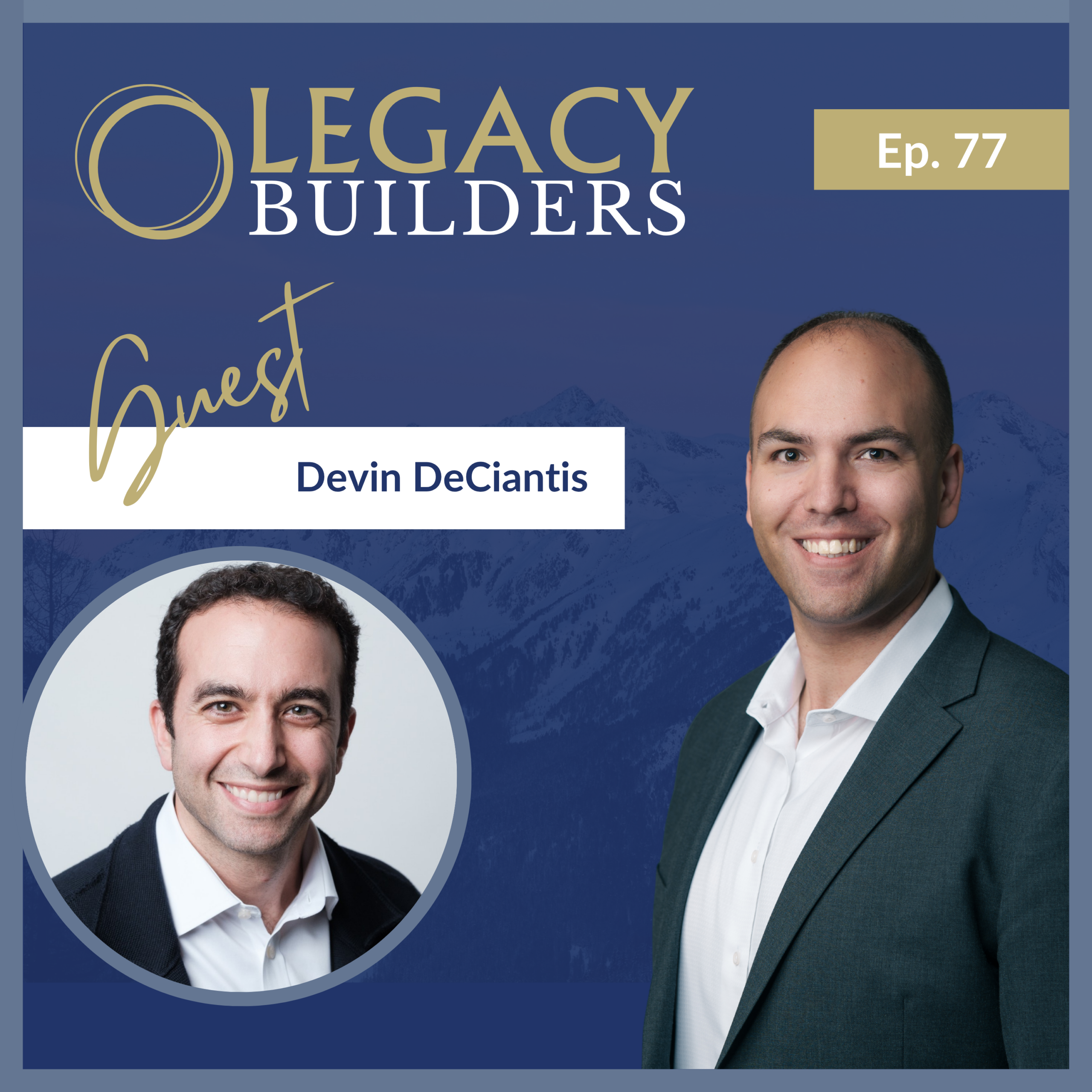
In this episode, we’re joined by Devin DeCiantis, Managing Partner at Lansberg Gersick Advisors. Devin has spent years studying how family enterprises endure across generations, focusing on governance, risk, and resilience. Our conversation explores how culture and history shape the way families respond to uncertainty, why long periods of stability can create complacency, and what it means to build resilience before a crisis arrives deliberately. We also discuss intergenerational responsibility, migration, institutional trust, and the idea of paying a “resilience tax” today to strengthen an enterprise for tomorrow.
Devin invites us to consider how families can prepare for a future that may look very different from the past, while building the capacity to adapt, endure, and continue across generations.
About Devin DeCiantis
Devin DeCiantis is a trusted advisor to the world’s leading family enterprises and the Managing Partner at Lansberg Gersick Advisors (LGA). With an MPP from the Harvard Kennedy School and years of research into organizational continuity, Devin and his team help business families design robust governance systems that bridge the gap between short-term goals and long-term stewardship. He is the co-author of “The Enduring Enterprise” and the forthcoming book, “Governing Complex Family Enterprises: The Seven Drivers of Continuity”.
Resources discussed in this episode:
- The Enduring Enterprise
- Generation to Generation: Life Cycles of the Family Business
- Succeeding Generations
- Jim Grubman
- Dennis Jaffe
- Governing Complex Family Enterprises: The Seven Drivers of Continuity (Upcoming)
Contact Cory Gagnon | Beacon Family Office at CI Assante Wealth Management Ltd.
- Website: BeaconFamilyOffice.com
- LinkedIn: Cory Gagnon
- LinkedIn: Beacon Family Office
- Email: beaconfamilyoffice@assante.com
- Podcast: Legacy Builders Strategies for Building Successful Family Enterprise
Contact Devin DeCiantis | Lansberg Gersick Advisors (LGA)
- Website: lga.global
- LinkedIn: Devin Deciantis
- Newsletter: The Resilience Playbook Newsletter
- Email: deciantis@lga.global
Welcome to Legacy Builders, strategies for building successful family enterprises. Brought to you by Beacon Family Office at CI Assante Wealth Management Limited. I’m your host, Cory Gagnon, Senior Wealth Advisor. And on this show, we explore global ideas, concepts, and models that help family enterprises better navigate the complexities of family wealth.
Today, we welcome Devin DeCiantis, Managing Partner at Lansberg Gersick Advisors. Devin advises leading family enterprises on the governance and continuity challenges that come with thinking beyond the next decision or generation. With a Master in Public Policy from the Harvard Kennedy School and years of research into organizational continuity, his work focuses on helping business families build governance systems that connect near-term priorities with long-term stewardship. He is also the co-author of The Enduring Enterprise and the forthcoming book, Governing Complex Family Enterprises: The Seven Drivers of Continuity.
My goal is to be the most curious person in today’s conversation with Devin as we explore what resilience looks like when family enterprises can no longer assume tomorrow will resemble today. Devin brings forward the idea of a “resilience tax”: the investments families make in preparation, flexibility, and continuity before disruption ever arrives. The conversation also touches on how long periods of stability can shape the way families think about risk, and why enduring enterprises are often the ones willing to prepare for conditions they hope never come.
Now, let’s dive in!
Cory: Welcome, Devin. We’re excited to have you here today to share your wealth of knowledge and experiences with us. Let’s dive in, shall we?
Devin: Alright. Thank you so much for having me.
Cory: Devin, imagine you’re delivering the commencement speech to the graduating class of 2026, and you have the chance to inspire them with your story. How would you begin your speech to convey the incredible lessons and expertise you’ve gained along your career?
Devin: That’s a great question, Cory. To kick things off, I suppose if I were to start a commencement speech today, I probably wouldn’t begin with business strategy, or wealth management, or governance. None of that might even be interesting to the audience necessarily. But I’d probably start with a lesson that I learned as a boy in scouting many, many years ago, when we were taught a simple but profound rule to always leave the campground better than you found it.
The logic seems obvious. At the time, it was just about picking up trash as we moved through nature. But as my career evolved, and I went on to study business and then public policy, and then to begin helping some of the world’s most complex family enterprises navigate these complex generational transitions, I realized that this is the absolute essence of true leadership. In fact, that we’re not just temporary stewards of the institutions that we lead or that we own, whether that’s a small campsite or a multi-generational family enterprise.
And I suppose also I’d probably tap the old scouting wisdom, the old motto of “be prepared.” Having written a lot about risk and risk management and continuity, it’s not just about packing an extra flashlight or protein bar, but it’s a mindset of proactive resilience. I’m sure we’ll get into some of that over the course of our conversation today. But really, it means anticipating the storms before they hit, and putting ourselves in a position to respond more effectively to whatever life throws at us.
Cory: I love bringing some of those childhood lessons in and reminding people of some of those institutions we have in our life that we sometimes take for granted. You think about the scouts, and you think about the guides and so many of these great institutions that we have to help form, our children, our society, into great stewards.
And so Devin, as you think of some of those rituals and traditions and teachings, what is it that you see in the work that you do today and the families that you work with where some of those maybe aren’t so formal and written and taught, the same across languages and cultures, but maybe they are, what do you see there?
Devin: It’s a fascinating topic that I know some of your other guests have literally written books about. As I think about the way in which we learn and sense-make about the world, especially at a very early stage, the first institution that we are a part of is ultimately the family.
Confucius wrote about this twenty-five hundred years ago, and Plato has commented on the family as the fundamental building block of society. And so in many ways, we first learn about authority, power, communication, and collaboration in the construct of our households. And oftentimes, it’s informal. It’s not what people are saying. It’s what people are doing. And so I think it’s a fascinating lens into the early informative role that families play in shaping our worldview and setting us up to be able to navigate the cultures within which we’re embedded more effectively.
Now, as you pointed out, those cultures are very different in Western Europe and the advanced economies of The Americas, very much so different than the Far East, or than South Asia, or than Latin America, or than all of Africa for the most part. And we’ve got situations where those cultures are either oriented around individualism, or collectivism, or honor, as folks like Jim Grubman and Dennis Jaffe have written about, quite compellingly. They also are related to places and times, so that culture itself is a moving target. And depending on the generations in which we emerged and lived within, our respective societies, we are going to be shaped by the successes and traumas of those societies.
And so, if you look back, even in the most advanced economies of the world today, you’ve got to go back almost a century to find any form of significant adversity. We’ve been living in this sort of abundant era, sort of eighty-plus years of more or less political and economic stability. And now, we’re bumping into a new age of uncertainty. Perhaps, it looks a lot more like the first half of the twentieth century than the second half of the twentieth century, and that’s changing the way in which the youth of today are being raised, the value sets that they’re embracing, and their sense of possibility and risk.
And so I think culture is a huge driver as we sense-make around the world. And our families are the first sort of construct within which we begin to interface with that outside world, and can powerfully shape how enterprising families craft their organizational cultures to match not only their family culture, but also to be aligned with the communities within which they are active.
Cory: Right. And when you think of leaving the world better than you found it, and maybe this is said differently in different languages, but what have you seen as far as, not only from a public policy perspective, but more from the families themselves that you work with, and those communities and smaller organizations, where that is inherent or ingrained in them?
Devin: I think it’s an interesting question, because you frame this at the societal level and at the familial level within a single organization. It really is, in both cases, about intergenerational equity.
To what extent are we investing in a future that some members of the community will not directly participate in, and how much of the benefits of the current model ought to accrue to those who have produced that success and have contributed to and invested in the infrastructures that have enabled it? To what extent ought we to pay it forward into future generations and take some of the benefits off the table that we won’t get to enjoy ourselves and make sure that they’re available to our kids? That’s as true for societies that are grappling with issues such as climate change. To what extent ought we to throttle our economic activity in the present in order to make sure that the planet and our communities are livable half a century or a century from now for generations as yet unborn?
And within enterprising families, similarly, how do we think about how much of the resources within our enterprises ought we to make available to the owners, through liquidity, to reward them for risking their capital within this enterprise? How much of this should be set aside for future generations? How much of this should be reinvested in the enterprise itself and its other internal stakeholders, employees, and customers, and suppliers, and distributors, and the communities within which these organizations are embedded?
And so that the question of intergenerational equity or justice is one that is just as relevant today at the societal level as it is within enterprising families themselves.
Cory: And, Devin, as you mentioned, strategy and risk management, and I’d love to go there. I’m struck by the word that you use, trauma. And just as far as that adversity that different economies have felt, and more recently, or more than a century in a lot of the world, where do you see that trauma show up as far as decision-making around risk?
Devin: I’ve been teaching about, researching, and writing about risk now for over a decade, and specifically the domain of family enterprise. But also, family enterprises don’t exist in a vacuum. They exist in an ecosystemic context. And so understanding that context is critical as families are planning for the future, especially decades into the future when some of these meta trends that might seem invisible today will manifest. In some way, that could be supportive of the family’s enduring success, or could inhibit it or undermine it.
So as we think about risk, the biggest challenge, of course, when we’re in a context that’s relatively stable, is just setting time aside to have that conversation. When things are quite comfortable, it’s easy to become complacent. Tomorrow will look more or less like today, and then two days from now will look more or less like tomorrow, and so forth. And you can plot those dots and set a plan for the future that is fundamentally just a photocopy, a carbon copy of today’s plan, because you’re going to wake up in the morning, and the sun will be shining, and the conditions for you to continue to thrive will essentially be present.
So the biggest challenge families who are operating in that flow of success and stable conditions have is contemplating a future that is anything but stable. And the reality is that, in recent years, they’ve been confronted with the very real risk that the world that is unfolding before us will, in fact, look very different from the world of the past, that two days from now may look very different from tomorrow, and tomorrow may look very different from today. And that’s not something that comes intuitively or has been built into the ethos of boardrooms and C-suites in most advanced economies around the world because of how stable things have been for so long. It hasn’t made sense.
It hasn’t been fruitful to have those conversations and explorations, the “what if” discussions, like what if tariffs tomorrow are quadrupled, with respect to our biggest trading partner, and how might that affect our enterprise? What if war breaks out in a neighboring country? What if drones show up outside of our manufacturing facilities? What if a cyber attack encroaches on our enterprise in some way, whether it’s controlled by humans or by the machines themselves? All of these things sound like science fiction, and yet it’s healthy for us to begin to contemplate them as we come into contact for the first time in nearly a century in advanced economies, these issues.
The interesting insight that, as we were studying this, became apparent to us, it was sort of hiding in plain sight, was that there are, in fact, places around the world where that kind of risk climate, that kind of uncertainty, is the rule rather than the exception. And that family enterprises in those countries, in those regions, are more attuned to risk naturally, because the big risks that they are confronted with aren’t hundred-year storms. They’re just a sort of seasonal shower. They’re used to this because they can’t go for long without one of them presenting themselves as a situation that needs to be actively managed as a crisis or a shock to the enterprise, and so they have a natural agility. They can dodge and weave, and bounce back more quickly from adversity when it strikes because it’s a more familiar pattern. They have the muscle memory to adapt to it.
Cory: And, Devin, when you think of that adversity and that resilience, we talk about resilience as an individual. I think of resilience as a system. What do you find as you bring some of this to families where it’s been generations now that they really haven’t had to exercise those muscles and they’re seeing some of these conditions, or maybe you talked about this a decade ago and they’re laughing at the fact that you have to do this, how do we start those conversations when that muscle seems pretty weak at the moment?
Devin: That’s an interesting observation, Cory, the fact that we often don’t want to contemplate risk when it isn’t staring us in the face. And so we have to force ourselves into being comfortable with being uncomfortable. We have to stress-test our logics. There are ways that we can do this. In fact, we run simulations with families, both leveraging digital tools, but also the old-fashioned way, sort of wargaming in the room, various scenarios. And sometimes that can prime the pump for the exploration of alternative futures that we hadn’t previously contemplated. But I found it fascinating, really, to teach about risk before, during, and after the pandemic recently.
As you were approaching 2018, 2019, 2020, the last major structural shock to affect most enterprises worldwide, but certainly in the advanced West, was the global financial crisis, and it was about a decade in the rearview mirror. So if you look at a ten-year chart in 2019, it was a straight shot up. It looked like there was only one thing that could happen, which was the continued growth of the economy, the continued growth of financial markets, and so forth. And in many ways, it hid the reality of that traumatic two-year period. But it was so far in the past that we no longer gave it as much weight. We said, well, that that was then, and this is now. And things are different. We’ve learned our lesson, of course, the famous last words, this time is different. And then we proceeded into the pandemic, and everybody was like, my goodness.
Bill Gates had been talking about pandemic response in 2016, 2017. It was one of the most viewed TED Talks of all time. I think it was the World Bank or the United Nations. Some multilateral organization in New York City in 2019 ran a pandemic sim with world leaders and business leaders, and it turned out terribly, horribly wrong. The world went up in flames essentially as a byproduct of this thing. And months later, we had an actual pandemic, and didn’t leverage any of the lessons from that simulation just several months prior.
So even when faced and confronted with this, the reality is that we often resist talking about risk, thinking about risk, and I mean in the negative sense of it, as something adverse happening to us. Because, well, on the one hand, it’s a lot more exciting. It’s sexier to talk about strategy and growth, AI has transformational potential and is sort of the utopian ideal of the future. It’s often demoralizing or discouraging to think about the ways in which our plans can go sideways. But that, in fact, for family enterprises that are built to stand the test of time, they are the ones in fact that contemplate alternative futures that aren’t always the rosiest outcome.
And they invest proactively, to your question, in building resilience into their institution. It’s sort of institutional resilience at the core level internally, in terms of how they think about their markets, and in terms of how they invest in their ecosystems. So that when shocks actually occur, they aren’t as negatively harmed at the outset, they are able to recover more quickly, and in some cases, even emerge from the crisis better off than they were beforehand, because they had trained for this in a sense. They were ready for the shock before it happened. Not necessarily that particular shock, but they were ready for a shock of some form. And so they had the processes, the systems, the structures, the resources available, to respond to it more quickly.
Cory: And, Devin, when I talk to families, particularly in Canada and the US, in who I’m speaking with and bringing up some of these topics, it’s often seen that risk management is a draw. It’s going to take away from future return potential if we invest in it. And so when you, and I love as you mentioned, emerging from the crisis stronger and able to bounce back quicker, I’m wondering if you have stories where you can kind of demonstrate that it doesn’t need to be always, we’re going to give up future profits because we’re investing in this, and maybe we are and that can be okay. But I wonder if you’ve got some examples where you can say, we’re not just doing this so that we don’t go bankrupt, but we’re actually doing this, and it can show that we were stronger in the long-term for it.
Devin: Absolutely. Obviously, we can’t talk about our specific client cases, but the world is replete with examples. And that was what we were studying in our original research, was to find publicly available cases where families had deliberately invested in resilience longitudinally. This isn’t just a one-off and they got lucky, but this is an organization that is committed to enduring, to generational continuity.
And as a byproduct of that, they’re willing to pay what I’ve enjoyed calling the “resilience tax,” if you will. And to your excellent observation, this is often experienced like a tax.
This is something that I have to pay in order to achieve the thing that I’m aspiring to. And that it’s a trade-off that investing in excess inventories, so putting aside warehousing critical parts for our supply chain costs money and takes up space, and it requires us to set aside working capital that could otherwise be deployed in more productive ways, and then, the Strait of Hormuz shuts, and we can’t get particular raw materials or commodities out of this trapped channel. And that’s precisely when we can look to our warehouses and our stores of these critical materials, fertilizers, and certain feedstocks that become a competitive advantage in that moment.
The most valuable asset that one can get their hands on, because nobody else can, and you’ve got a whole warehouse, or a whole tank of this stuff sitting there waiting to be deployed.
It’s that kind of proactivity that requires the discipline to set aside the capital in the first place, to set aside the space, to set aside the funds, and to build into your operating model this kind of redundancy. And so we, as a byproduct of our research, ended up identifying, in addition to redundancy, which is one of seven stabilizing strategies that we saw around the world, a variety of organizations invest in deliberately to increase resilience. The others being things like modularity and simplification at the core level, the internal level. We’ve got differentiation and diversity in the marketplace, entire chapters in the book, and cases, organized around that.
And then, in terms of our ecosystemic resilience, we have symbiosis, so the degree to which we connect ourselves and work with government, political actors, and power brokers, as well as community power brokers, so that our strength and resilience is tethered to the other major players in the ecosystems within which we play.
And then migration. At some point, things become so intolerable where we are operating, or so attractive elsewhere, that we actually have to move into a new garden, so to speak, and begin pollinating elsewhere.
These seven strategies we saw time and time again playing out among the most enduring enterprises that we studied. And it does cost money to invest in these strategies, as with most strategic initiatives. But when a shock eventually hits, this is precisely the moment in which that investment pays huge returns. In fact, there’s a great piece of research out of BCG that was conducted in 2020 in the midst of the early stages of the pandemic, that assessed twenty years worth of organizational performance across over 1,500 companies, publicly traded companies in the United States.
And fully 30% of their outperformance in those first-quartile companies within that study outperformed because of how they did during a crisis. So it wasn’t just how well they were racing ahead when times were good. It was how well they performed when everybody else was reeling and struggling. And the ones that set resources aside to be an all-weather company, so to speak, to thrive in all seasons, were the ones that, over the long run, outperformed.
Cory: And my curiosity around migration, I think of so many of these families and amazing examples of, even what’s gone on in Ukraine over, unfortunately, many different crises. Those wonderful Ukrainian people have moved around the world and brought tremendous amounts of entrepreneurship with them. And so when you think of that migration, where do you see those examples in certain cultures of business that it’s more ingrained versus others?
Devin: First of all, the human story is filled with tales of migration, sometimes voluntary, in search of opportunity and fortune, and sometimes forced, in terms of being expelled from the place that they would otherwise have called home, due to political, cultural, or environmental reasons. And businesses will face those similar pressures. But because we’re talking about family enterprises, it’s often deeply tied to identity. And the decision to uproot and move is not one that’s often taken lightly.
In the book, we talk about this fascinating case, a family that we met many years ago, based in Syria, that had been in business for almost a hundred years. And then in the 1960s, their business was nationalized by the Syrian government. It was a white goods manufacturer of appliances, and then they had a whole supply chain around that, which they built out. But in the face of that, they essentially migrated to nearby Lebanon, set up shop again, rebuilding their business from scratch without any of the financial and physical capital, but with all the human capital still intact. So they at first became advisors to other appliance manufacturers. And so, got into consulting, and then built up some more capital, and then began to reinvest in their own manufacturing capacity. And over the ensuing decades, rebuilt their empire based out of a neighboring country into a multinational, with a footprint in industrials and in chemicals and. So basically, I had to start from scratch in a new place and then build it up again. And there’s so many examples of this.
We talked to families that had to deal with the separation of India in the late 1940s, and waves of Muslims who had to move from then India into West Pakistan, or many Hindus who had to migrate from West Pakistan into what then became India. And so you have this massive migration in both directions of enterprising families who had to uproot and rebuild their enterprises from scratch. And it was it’s just remarkable to see the push and pull factors, the things that were drawing them to choose their new location, often similar geography, a similar culture, similar sort of weather, and so forth, and an opportunity set, but distinct enough that they were able to leave the risk of expropriation or personal harm behind. And it’s inspiring actually to see that families can hold together in these communities.
Interestingly, itinerant communities like this who set up an outpost in a new country often try to find like-minded members of that same cultural community and support each other. Whether it’s the Jewish diaspora, or the Ishmael diaspora that it is well known for, in whatever country where they find themselves migrating to, finding communities of commerce and trade and business to support one another, and to make sure that those who are migrating into this new land have a welcoming spot and a community to plug into to help sense-make and then to learn the new customs and so forth of those cultures and better assimilate, so that they can thrive in this new location.
Cory: Absolutely. And Devin, you made a comment about the financial crisis, and we’ve seen these periods where central bankers have pretty much pulled every lever that existed and created new ones to stabilize the world. When you think of other mechanisms out there to create stability, I love the at the ground level of organizing ourselves and creating some ecosystem that allows us to trade easier, and you made some comments about government relations, where do you see some of the best effort spent to create or to understand those stabilizers when it comes to family enterprise?
Devin: One of my favorite quotes about this is by a former prime minister of Great Britain, Gordon Brown, who said, when establishing the rule of law, it’s the first five centuries that are the most important. And the reason I love that is that it gives you a sense of the time horizon it takes to incubate an institution, a government public institution, and the amount of trust that is imbued in those institutions to allow for commercial transactions ultimately with strangers.
The peaceful coexistence of societies requires these kinds of stabilizers from the rule of law, to simple norms about which side of the road we’re going to drive on, and how we’re going to access ports, and the safety of the food and drink that we consume, and the currency that we all trade and exchange in order to procure the goods that we need and to supply the things we can. All of those institutions take centuries to build. The trust in those institutions takes centuries to build. And it’s probably the most distinguishing characteristic, at least in our study of the phenomenon of advanced economies, is that the institutions themselves are among the most sophisticated and complex, and project most into the environment so that you’re creating maximum stability. It’s not a guarantee, but sort of operating as a business in Canada is kind of the equivalent of driving a drag car.
There’s like all it has to do is drive really straight and as fast as possible. And you trust that the track operator is going to make sure there are no bumps in the track, the parachute behind the thing works, all of that stuff. And you’ve got medical teams on either side, ready for you. But all you have to do is go fast and go straight.
If you go a little further down the developmental ladder in terms of these economies, there are fewer stabilizers in place. The metaphor might be a Formula One race track where you still need to move quickly, but now we need to move laterally. And every so often we’re going to have to slow down. There’s going to be a hairpin turn, and we’re going to have to redirect.
And then you think about a frontier economy, and it’s kind of like a dirt race. A Subaru is probably your best bet. Your four-wheel drive. And this thing can crunch through gravel and go up and down hills, drift around a tree if you have to, on your path to the finish line.
The reality is that the businesses that operate in each of those places are optimized for the amount of stability that’s provided by the circumstance in many ways by the government. We have social safety nets. We have financial regulators. We have health regulators. We have travel regulators. We have folks that are looking out for all the ways in which markets not only can succeed, but in particular, governments tend to focus on how markets fail. And so put in those stabilizers to address them. That’s the way they teach micro and macroeconomics, at least at grad school. When I was at the Kennedy School, it wasn’t, you know, micro 101 and macro 101. It was markets and market failures. And the presumption was that markets can do many things, and they are prone to predictable failure.
The consolidation of power, influence and control in a monopolist, and the rent-seeking behaviors that enable that. And in certain industries, that’s more likely than others. So what can governments do to discourage that kind of concentration of capital and power and influence, because ultimately that doesn’t produce the best outcomes for an entire society. It’s the advanced economies of the world, historically, let’s just say, that have embraced that logic whereas merging in frontier economies are still building up their institutions, but it’s a bit more of a free-for-all. And so there’s more latitude to move.
And so, as we think about building stability, it’s these institutions that prevent bank failures, for instance, from cascading from some arcane part of the financial system into a massive global crisis. It was the advanced world that mobilized the new approach to stabilizing the financial system and allowing the rest of commercial life globally to continue to function. Eventually, it took some time, but the leadership came from the most advanced economies where the institutions were most sophisticated and empowered to be able to address some of these issues, whereas in other parts of the world, it was much more painful to have to operate and navigate. You’re essentially on your own to manage the volatility that unfolded in that time, and many businesses failed as a byproduct of not having access to rescue funding or other market stabilizers that then allowed them to continue operating.
Cory: I love the metaphor of the race cars. The Subaru can probably go down the racetrack straight, maybe not as fast if they were racing a drag car. But it’d be pretty hard for that drag car to go on the dirt track and even function next to the rest of those Subarus. And so when you think about some of those stabilizers and the trust that maybe is, I’m not going to say necessarily deteriorating, but being questioned in some of these stabilizers that we have, how do we prepare our car for, maybe a few more turns of the F1 track than what we’ve normally expected?
Devin: I think the best way of attending to that, is of course, unfortunately, to no longer rely on, at least for the time being, a commitment to creating an equal-level, stable playing field for all participants. And in the absence of that, recognizing that for many years, one might argue that countries further down the developmental ladder, that Mexico was becoming more like America so to speak, as it was maturing as an economy and so forth. But it seems now like America is becoming more like Mexico in the sense that it is descending back down. It is removing a lot of the stabilizers that have previously allowed society to peacefully and productively collaborate. And that means that the businesses who operate there need to begin to invest in those stabilizers themselves. They need to pay that resilience tax directly, as opposed to having the taxes that they pay go into a public fund that is investing on all of our collective behalves.
Cory: That is a great way to say that, because as you were mentioning that resilience tax, I was thinking about, okay, so we can pool our money and think that that’s creating it for us. But at this point, maybe we can’t rely on that pooled money necessarily. And what are we doing on our own?
Devin: Remarkably, within the family enterprise community, there are in fact groups of enterprises that are mobilizing. I can say with pride that some of Canada’s leading enterprising families gather and discuss the role of business in society beyond sort of the shareholder capitalism that has been in vogue for the better part of the last forty years, that a stakeholder version of capitalism, one might argue a family version of capitalism is emerging as an antidote to, or an alternative to the pursuit of profitability and growth above all else. And the recognition that business actually has to renegotiate its social contract with the societies within which these businesses are active, because customers are pushing back, employees are pushing back.
And governments, some of them at least, are expecting more of their national champions to contribute back into the environment that has been so generous to the families that have been successful over generations. And I’m proud to say, at least here in Canada, that the families that I know well are leaning into this ask of them.
I went to grad school, the Kennedy School of Government. And so, the ethos is baked into us, “Ask not what your country can do for you, but what you can do for your country.” And I like seeing this out there in the world increasingly, and do everything I possibly can to support the families who are leaning into this challenge.
Cory: And what a great plug for the great organizations that are helping this happen, some larger than others. And I think, good on the families who are participating and stepping up to say, what is it that we can do collectively to continue to steward the way that we have? And I think, doing a great job thus far, and prepared to do even more, which is tremendous.
Devin: Absolutely. And if you’re listening to this and a family out there who is doing this but not doing it with others or seeing others moving with you, reach out to Cory and I. We’ll connect you. It takes a village. And by all means, if this gets you excited, there’s lots of work to be done and would love your help.
Cory: Absolutely. Devin, as we near the end of our conversation today, there’s a few questions that I ask each guest before we wrap up. Are you ready for the tough ones?
Devin: Yes.
Cory: Alright. What is one key strategy that you believe is most essential for building a successful family enterprise?
Devin: If I had to pick just one, I just mentioned seven within this ethos, but it’s really about focusing on resilience. You can plan for all of the world to unfold in all the ways that you hope, but also brace for the world not unfolding quite as you’d expected. And the real challenge is to balance your pursuit of growth with your investments in resilience. Most business schools will teach you to optimize for just-in-time efficiency. But the reality is, if you can focus on a “just in case” mindset, I think it will serve you better in this new age of uncertainty that we are entering, and I think it’s going to be an investment that will pay significant dividends, even if in the moment it feels like an expensive tax.
Cory: And Devin, as you’re saying that, I think, my goodness, he sounds like an old soul. But I can tell listeners he’s not that old. And it’s one of those things that it’s not just the old wise guy or wise man who can say, I’ve lived through this, and you need to, I think it’s wisdom across all ages that says that that is a good strategy.
Devin: Well, if we can we can help our client families and other families out there who are committed to multigenerational success to look to other sources of inspiration beyond the traditional sort of Western business school. Look to other places. Look to history for anecdotes here, and inspiration on not only the kinds of things that can unfold, the types of opportunities and shocks that might present themselves in the years ahead, but also the different approaches to dealing with them. You might not want to replicate them exactly, but expand your toolkit. Broaden your horizons. Look to alternative high priests in the business world beyond Silicon Valley and Wall Street, and I promise you, it will serve you well in the years and decades ahead.
Cory: Amazing. And what is the most common challenge that you see family enterprises encountering when it comes to wealth transition and generational continuity?
Devin: One of the biggest challenges that we see in virtually every family that we work with, to varying degrees, is the educational void, if you will, or this sense that the family will learn through intuition and observation that which it needs to understand fully in order to be effective stewards of the enterprise, either as leaders, as operators, or as governing owners, or even as engaged owners in a larger system, and that these family enterprises don’t come with an owner’s manual.
They may come with a shareholders’ agreement and some other policies, prenups, and things like that. But somebody putting an F1 vehicle’s owner’s manual in your lap and having you read it is very different from you sitting in the cockpit and driving this thing effectively. And so the education is not only sense-making and building awareness of all of the things that we need to understand in order to be effective stewards and collaboratively lead our family enterprises into the future, but also practical experience. You need the sort of inductive and deductive exposures that will enhance your capability to be able to be an effective steward and owner of your family enterprise. And you can do that deliberately in-house. You can go to campuses. You can build bespoke academies.
Many of our clients will commit to building out learning academies for their families, longitudinal journeys over multiple years that can level up and build a pipeline of talent within the family, as well as greater engagement and vocabulary for communication about the family business. But this is one place where, again, almost like a resilience tax, families often recognize and acknowledge the value of education, but don’t always commit deliberately and strategically to investing in it. And so I highly recommend that families at least consider this. And, again, it doesn’t need to be something done on your own, because there’s some great groups of families that have come together to combine those resources and do it well.
Cory: Absolutely. And Devin, in your experience, what are the top three key qualities that successful family enterprise leaders possess?
Devin: It’s another terrific question, and to boil all of the different competencies, skills, and qualities down to just three is always a challenge. In fact, my dear friend and colleague, Yvonne Landsberg, and I, are writing another book together on continuity planning in complex enterprises. And there’s a whole chapter on leadership, and at this point, we’re trying to boil it down from 15 to, like, seven. So you’re really challenging me to pick three here. But I guess the three that float to the top, for your consideration.
One is character. You can go back into history and look at the ancient Greeks and those scholars in the Far East, and even in the Middle Eastern traditions, where character is the foundation of all effective leadership.
Stewardship requires leaders who can subordinate their personal agendas for the long-term benefit of the collective, whether that’s an organization they’re running or a society that they are leading. And in a family business where these personal relationships and business interests overlap, character is one of the things that can help to maintain trust and credibility. And so, operating with integrity as a leader is essential.
You also need to show true proactive judgment. So you can be technically brilliant and have all the competencies on paper, but good judgment is actually quite a rare asset. Leaders in family enterprises especially face all sorts of paradoxes. They have to balance competing interests in the business among owners and within the family. And so these aren’t puzzles necessarily to solve. These are situations to actively manage over time. So you need to be able to discern the appropriate course of action when there are always competing interests. And as one of our colleagues likes to say about adaptive leadership, the challenge is to disappoint people at a pace they can tolerate. That’s one of the surest ways that you know that you’re being effective as a leader in the service of change.
I guess the last one is humility. It’s possibly the least explored of all of the qualities or competencies of leaders. That’s not what we would often think of when we think about the hero in the more traditional or mythic sense of that term. Movies like The Odyssey out there, promoting a particular form of leadership, and maybe even critically so. The best leaders know that they’re just temporary custodians. It goes back, in fact, to the Boy Scouts and that stewardship mindset, that the best leaders don’t necessarily even have formal authority within a system, but they have informal influence and legitimacy within the system, and are able to deploy their energies in service of something that’s bigger than themself, and the humility to know that that power is only transitory, and to wield it with discipline and with care. Its humility is what turns a boss into a steward.
This isn’t just about the sign on the door or the fancy office. It’s an important role in an organization, and one that you are only temporarily holding. Even folks who are in power and leadership for a half century eventually will step away by choice or by force. And I think humility helps keep them effective longer if they can embrace it and not let the power get to their head.
Cory: Absolutely. That was a great three out of many. And I can tell that you’ve been thinking about that one. So I look forward to that chapter when it comes out.
Devin: You got it, Cory. It was just a teaser. We’ll give you the others once the book is finally done, hopefully early next year.
Cory: That’s great. Devin, I would love to highlight where our listeners can engage in more of the conversations you’re having, the resources that you only briefly touched on that I would love for you to give a plug for, and where our listeners can find you.
Devin: Well, thanks for that, Cory. I’m the managing partner at LGA, which is a global boutique advisory firm. We’re over 50 really wise and caring advisors who support enterprising families around the world with precisely these kinds of questions and topics. And we have a wealth of resources there, articles, newsletters, podcasts, videos and such, for families who are curious about learning more about continuity planning, and in general, ways in which families around the world pursue this, case studies and such, where our goal is to make this information as widely available as possible.
We’ve also written a couple of books, the Generation to Generation, written by my amazing colleagues, Kellen Gersick, Yvonne Landsberg, and some other colleagues from other of the leading firms in the advisory space. And then, Yvonne wrote Succeeding Generations, which is, twenty-five years after its publication, still among the best books ever written on the topic of succession in family enterprise. And then, The Enduring Enterprise is the book that we were alluding to throughout our conversation here today. We released that a couple of years ago, on the precipice of a world that seemed to be coming undone a little bit. And so it’s filled with a whole bunch of insight on thinking about paying that resilience tax, but with confidence and competence, and navigating turbulent times.
So those are a bunch of places where you can find us and reach out. Our contact information is on the website. You can reach out through LinkedIn. I’m not particularly attentive to social media. I apologize in advance. I’m a conscientious objector, but I do get on there as often as I need to be. So please reach out if we could ever be helpful.
And Cory, thank you so much for inviting me to participate in this incredible project. I hope it was useful to you and to your listeners.
Cory: Absolutely. And Devin, just before we let you go, I wanted to make sure that we covered everything.
If there’s anything else you’d like to share with our audience that maybe we didn’t get a chance to touch on, I’d love for you to have a moment to to mention anything that, that wasn’t wasn’t touched on.
Devin: Honestly, I feel like we covered quite an array of topics here today. Happy to continue to go deeper, obviously, Cory. But in general, just supportive of families out there who are trying to look around the corner and anticipate both the unique aspects of their own continuity journey that are particular to their family, but also the generic challenges of sustaining the unity and commitment and performance of an enterprising family across generations. And just know that there are terrific resources out there, including this podcast, to support you on that journey. And whether it’s the team at LGA or anybody else out there, wishing everybody the best of luck with that.
We’re going to need all the hands pulling in this direction in order to help not only our current generation, but future generations of enterprising families continue to survive and thrive. So anything we can do to help with that, you know where to find us.
Cory: Amazing. Well, thank you, Devin, for taking the time to share your expertise, your experiences, the great stories, with us today. You and the wonderful colleagues you have at LGA do a tremendous amount of work to advance this area. And I know that your insights have been incredibly valuable to me, and I’m sure that our listeners will find great nuggets from your contribution to this episode. So thank you.
Devin: Thank you, Cory. It was a pleasure.
As we wrap up this episode, we invite you to reflect on Devin’s perspective that resilience is built long before disruption arrives. For family enterprises, that means resisting the assumption that stability will continue and investing in the systems, resources, and relationships that help them respond when conditions change.
Whether you’re part of a family enterprise or walk alongside one, this conversation reminds us that preparedness carries a cost, but so does complacency. Looking beyond immediate returns can create the capacity to absorb shocks, adapt with confidence, and steward the enterprise with future generations in mind.
Throughout our conversation, Devin brought attention to the discipline required to prepare for futures that may be difficult to imagine. He shared how stress-testing assumptions, building adaptability into the enterprise, and learning from environments where uncertainty is more familiar can strengthen an organization’s ability to respond. Perhaps his challenge to become “comfortable with being uncomfortable” captures it best: enduring enterprises develop the capacity to face uncertainty before circumstances force them to.
To continue learning from Devin, you’ll find links to Lansberg Gersick Advisors, his books, and additional resources from today’s conversation in the show notes, along with ways to connect with him directly.
Disclaimer:
This program was prepared by Cory Gagnon, who is a Senior Wealth Advisor with Beacon Family Office at CI Assante Wealth Management Ltd. This is not an official program of CI Assante Wealth Management Ltd, and the statements and opinions expressed during this podcast are not necessarily those of CI Assante Wealth Management Ltd. This show is intended for general information only and may not apply to all listeners or investors; please obtain professional financial advice or contact us at BeaconFamilyOffice@Assante.com or visit BeaconFamilyOffice.com to discuss your particular circumstances before acting on the information presented.
