

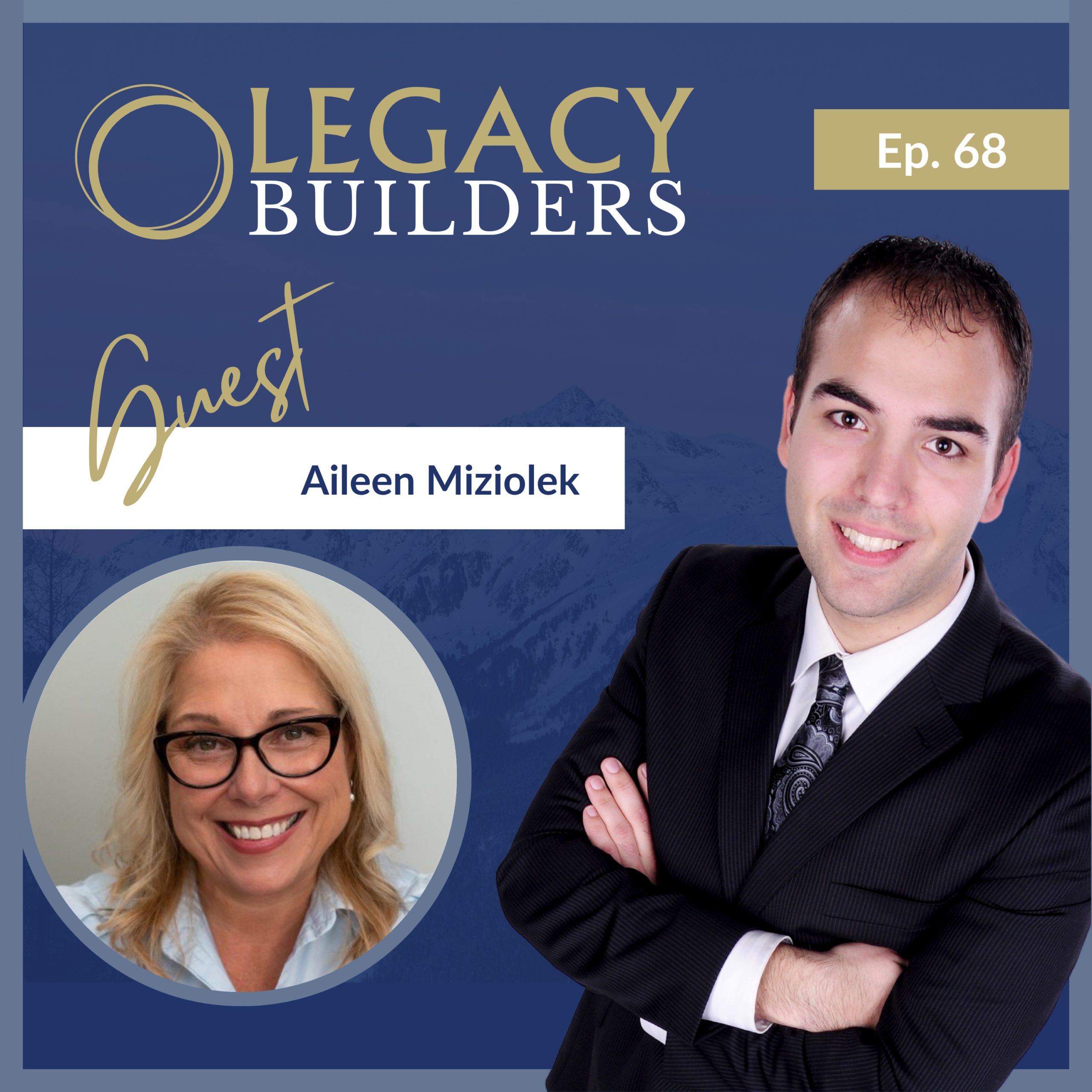
Leading Before the Role: How Family Enterprises Shape Future Leaders
LISTEN ON YOUR FAVOURITE PLATFORM
In this episode, we’re joined by Aileen Miziolek, a consultant with The Family Business Consulting Group, where she works with business-owning families to design strategies and processes that support both enterprise success and healthy relationships across generations. With more than 20 years of experience in complex financial and estate planning, along with designations in financial planning, family enterprise advising, and systems coaching, Aileen brings both professional depth and lived understanding to her work. Her roots in a farming family, experience as an entrepreneur, and work as co-author of Inspired Wealth: Financial Leadership for the 21st Century all shape the way she supports families through questions of wealth, ownership, legacy, and change. Our conversation explores what can happen when families slow down long enough to notice the patterns shaping their decisions.
We talk about the space between what has been inherited and what can still be chosen, especially when legacy, ownership, and relationships are all in motion. We also look at why families sometimes need to pause before they can move forward and how honest reflection, careful listening, and openness to new ways of thinking can create more room for trust, learning, and better decisions across generations.
About Aileen Miziolek
Aileen is a consultant with The Family Business Consulting Group, where she helps business-owning families navigate the complexities of continuity, succession, estate planning, and intergenerational wealth transfer. With more than 20 years of experience in complex financial and estate planning, she brings a multidisciplinary perspective to her work as a Certified Financial Planner, Family Enterprise Advisor, Certified Coach, and Organization and Relationship Systems Coach. What makes Aileen’s perspective unique is that she understands family enterprise from both a professional and personal lens. Her family business roots began in farming, and as a young entrepreneur, she launched her first start-up at age 25 before selling her first business a few years later.
Contact Cory Gagnon | Beacon Family Office at Assante Financial Management Ltd.
- Website: BeaconFamilyOffice.com
- LinkedIn: Cory Gagnon
- LinkedIn: Beacon Family Office
- Email: beaconfamilyoffice@assante.com
Contact Aileen Miziolek | The Family Business Consulting Group Inc.
- Website: aileenmiziolek.com
- Instagram: @aileenmiziolek
- LinkedIn: Aileen Miziolek
- Email: miziolek@thefbcg.com
We’re bringing together leading experts to tackle some of the most pressing challenges facing family businesses today, from succession planning and governance structures to preparing the next generation for leadership roles. You’ll walk away with actionable strategies and fresh perspectives on building resilient family enterprises.
Haven’t caught one of our webcasts yet? No problem. All previous sessions are archived and ready to stream whenever you’re ready to dive in. Simply head over to legacybuilderswebcast.com to register for our upcoming session or explore our growing library of past conversations.
Welcome to Legacy Builders, strategies for building successful family enterprises. Brought to you by Beacon Family Office at CI Assante Wealth Management Limited. I’m your host, Cory Gagnon, Senior Wealth Advisor. And on this show, we explore global ideas, concepts, and models that help family enterprises better navigate the complexities of family wealth.
Today, we welcome Aileen Miziolek, a consultant with The Family Business Consulting Group, who works with business-owning families to design strategies and processes that support both enterprise success and healthy relationships across generations. Aileen brings more than 20 years of experience in complex financial and estate planning, along with designations in financial planning, family enterprise, and systems coaching. With roots in a farming family and experience as an entrepreneur, she brings both professional expertise and lived understanding to her work. She is also the co-author of Inspired Wealth: Financial Leadership for the 21st Century, a guide to making critical life choices about money to create a fulfilling life.
My goal is to be the most curious person in today’s conversation with Aileen, as we explore what can happen when families slow down long enough to notice the patterns shaping their decisions. We’ll talk about the space between what has been inherited and what can still be chosen, especially when legacy, ownership, and relationships are all in motion. This is a conversation about awareness, choice, and the care it takes to grow through change.
Now, let’s dive in!
Cory: Alright. Welcome, Aileen. We’re excited to have you here today to share your wealth of knowledge and experiences with us. Let’s dive in, shall we?
Aileen: Absolutely.
Cory: Aileen, imagine you’re delivering the commencement speech to the graduating class of 2026, and you have the chance to inspire them with your story. How would you begin your speech to convey the incredible lessons and expertise you’ve gained along your career?
Aileen: So I’m going to start with a very personal story. My daughter’s room is directly across the hall from mine. She’s been gone ten years now, but when I walk into her room, and I do walk into her room every morning, I see her values everywhere.
Above the window there’s a single word spelled out in block wooden letters, hope. Beside her window there’s a vanity with enough makeup to last a lifetime. On the wall beside her door is a collage made up of tiny little Polaroid photos, 23 photos across, 18 photos deep, that document the last two years of her life, complete with dates and captions. And in the middle of that is one of those scratch maps, the ones that you scratch off the country when you go and visit. And above that is a photo, a snapshot of word art that says everybody dies but not everyone lives.
Eighteen years of her life are captured in this room, along with memory boxes and books full of songs and poetry. She started writing from the age of 10 to 18. Her values are everywhere. But what I would give to have had more conversations with her about those values while there was time, that’s where I would begin my commencement speech. Not with a list of principles, because Lord knows I’ve got lots of those, but with that room. Because the single most important thing that I want people to know, people who are building things that are meant to outlast them is that time is not money. Time is relationship.
I’ve spent a lot of time working with families, twenty five years working with business owning families, wealth creating families, navigating succession, estate planning, and governance, and what I’ve learned over and over again is that sharing DNA does not mean that we share meaning with one another, that we really know one another. We assume that proximity equals understanding. But we can sit across the dinner table from people you love most in this world, and still be utterly unknown to them and them to you. And that’s the reality of many families today.
Cory: As you think of those families that spend this time together and don’t really know each other, what is it that they’re missing?
Aileen: They’re missing understanding and the ability to create meaning together, because we have to know one another. First of all, you have to know yourself to be able to contribute to who are we together. Who am I first, and then who are we together. But I think a lot of times we are missing out on learning together, on building that relationship and understanding what we want to create together intentionally, and the opportunity to do that versus where we’ve just landed.
I think creating an intentional family culture is something that I really strive with my clients to do, because often they get caught in repeating family patterns, and they’re not always aware and conscious of that. And it’s often what creates conflict, and and not knowing that that’s what’s going on, they fall into this challenge around being able to resolve conflict. And often it is something we can learn to do with just better relationship skills, and knowing one another, and pausing and taking the time to be with one another. In that way, time is relationship.
Cory: I love that starting with “who am I.” Thinking of walking into somebody’s space and seeing those expressions of themselves. Why is it that we don’t know ourselves very well?
Aileen: I think there are some people that have a hard time really reflecting. I think a lot of that is fear. We spend so much time in trying to be maybe better, maybe perfect in some ways. I mean, today’s world, more than any time I think, really inspires a strong inner judge. Social media does that today.
I think in families of wealth where there’s great success, it’s always been that way, and I think that’s part of the challenge that people have when there is great wealth in a family, is how do we walk in our predecessors shoes? How do we fill those shoes? We know we’re walking on the shoulders of giants, and that’s a lot to live up to. So I think that generates a lot of a strong internal judge, and the internal judge is really fear-based. So we spend a lot of time becoming and trying to be, and feeling like sometimes we’re not measuring up. And yet, I think that’s where the great opportunity is in families, in learning together, because learning gets you off the hook from being perfect out of the gate.
And so why don’t we know each other or ourselves enough? Maybe we’re afraid to have those conversations together to help people see the vulnerability each person brings to that. I think that that is such an important part of family, that trust is created from vulnerability, and we have to trust ourselves, that we can aspire to maybe not the exact same thing that our predecessors did. And thank goodness, we have our own color of thread in the tapestry of family that we need to bring out brightly.
Cory: And so when you think of that thread or all those threads together, it seems so much easier from the outside to judge, to say, I know who that I can see what’s going on. How do we zoom out? How do we see that tapestry together and the beauty of what it is?
Aileen: Well, I mean, internally, individually, I think cultivating the witness. There’s a lot of good research, science, tradition, and meditation around being able to observe oneself and and look at things a little bit objectively. As a facilitator working with families, I often talk about putting the mirror up so they can see themselves and just being able to name what I see objectively. It’s hard when they’re in the family because they’re so entrenched in their patterns and they’ve not been in other families often, or that’s not true of people who have married into a family, let’s say, because they have their own family as reference, but most of us don’t have that, we know this is normal.
We can see what other families look like on TV, and from our friends and whatnot, and we learn that eventually. But it’s not apples to apples ever. So you’re looking at your own family and you’re saying, how are we functioning together? And asking the question and not being afraid to ask the question.
The first question I ask families when I start working with them is how do you want to be together? And exploring that. And then gently pulling up that mirror and saying, this is what I’m seeing now. What are you seeing? They’re getting curious about how they’re experiencing it, and having the courage and the safe space to be able to answer that truthfully as a gift to the family.
Cory: Thinking about those patterns and how they’re formed from those giants, and oftentimes, they repeat. Where do you see those patterns that serve families that they’re not saying this is a strength?
Aileen: I think that people do what they do until they learn something new. The world has changed, and what we know is how we were each raised. Even when I first got married twenty five years ago and contemplated starting my own family, we didn’t talk about psychological issues or challenges around things like that. There was just not a lot of that language or knowledge out there. It’s so emancipated today. There’s so much knowledge around mental health and well-being that way, mental well-being.
Often, these things are traditions and handed down, and so that, as I said, patterns repeat themselves until somebody in some generation says this is not working for us anymore, and we need to find a new way together. And that can be a really threatening thing intergenerationally for a family. It’s a threatening time for both generations because the older generation feels maybe some shame that they’re wrong. That comes into play here. And wealth is there, there’s a lot of desire to have perfection. These are high-achieving people. So that’s a difficult thing, our traditional family that got us here may not have the right skills to get us to the next level, next place.
And then the new generation also feels threatened because they don’t want to hurt their parents. Generally, they honor all that, but they can’t be authentic in the face of it. And they have a bit of a crisis that way because it’s not authentic to them. They can’t buy into that. So the opportunity, and it is an opportunity, a crisis and an opportunity. The opportunity is just to look at it together and say, how do we want to be together now in 2026? And perhaps over the next ten years, what we see is how do we want to shape the next generations that are going to rise? How are we going to create our future together? And I think that focus on the future is such an important thing, and I think that’s hopeful. I think that most people can buy into that once they’ve unfolded things in a process, in a way that honors both generations. One for wanting and just knowing what they’ve had, and one for having the courage to intentionally shape something new, and bringing them together not as wrong, but as learning from one another and generating well-being together in the future.
Cory: And as you ask that question of who do we want to be together, thinking about culture and tradition and what it takes to change patterns, how do we begin to form that new culture and live in the way that we aspire to live?
Aileen: You know, when we’re faced with change, I use the metaphor edge. We come to an edge. And crossing that edge can be scary. And some people will jump over the edge and cross quickly. Some people will dip their toe over and come back, and dip their toe over and come back, and then eventually cross. Other people won’t cross at all. And it depends on what the edge is. Some people will react one way or another, depending on the kind of edge they’re facing. And usually when they are at an edge, they’re agitated. The edge behavior is resistance, denial, blame. That’s what it shows up as. We see that as these people are difficult. But the truth is that they’re facing edges. And if you’ve ever stood on the edge of a cliff, it’s not a very comfortable place to be. And so we have to have some compassion for them and as a group.
But individually, we each have to be responsible to cross our edges and do the self-work. Learning is both vertical and horizontal. We have to learn within ourselves. We have to manage ourselves and our ability to change, because change is accelerating every day. The amount of change that we’re facing is unprecedented. And because we’re facing so much change, we’ve got to double down on processing that change together, individually and together. And that requires curiosity. Is everything I know about this really true still, or have things come to light that I should absorb in my identity, or in my thinking and in my mindset?
Having a flexible mindset is everyone’s responsibility. And it’s not about age. It really isn’t. We sometimes give a lot of excuses about age. I can’t teach an old dog new tricks, is a familiar saying. And we often give grace for that. And I guess there is some truth to that. But we’ve also known people who are flexible in their thinking, and agile and able to change and learn and want to do that, and are excited about doing that, or welcoming and future-focused. And I think that’s up to everyone individually to manage their mindset and be flexible, be able to be influenced.
Cory: Say more about being influenced.
Aileen: Well, you can be really rigid in your thinking, and this is who I am, and that’s who you get. And that’s not all that conducive to relationship. If we can’t influence one another, how do we then collaborate on how we want to be together? How do we teach each other? How do we learn from one another? How do we absorb what someone’s trying to tell us? And it’s true. Those are the cases that are the most difficult and frustrating for family members who have people that have that mindset in their families, and the most frustrating for people who are advising them. Because we must be open to influence in this world to survive and to thrive, because relationships need that from us. The families need that.
I’m a systems coach. And what that means is that I coach the system, the family as a system. So what does the family need? The family needs discussion, time to process, learning from one another, vulnerability, flexibility, and people that are open to influence so they can learn and implement what they’re learning together.
Cory: When you think of learning and development in organizations or in systems, what are those differences between thinking of of a corporate environment, non-family-owned business, where we’ve said this is what we’re doing in a in a workspace compared to a family and a family-owned organization, driving that that learning together?
Aileen: Well, in a corporate non-family business, we’re a team, and there’s a certain level of interdependence in a team for sure. But there’s a whole other level of interdependence in a family, tied to resources more so than in a team. Not to say that teams can’t have spiritual capital, but families certainly need it. They need to feel a sense of who are we together, where did I come from, what makes me and everyone around me, who are we together as a family? Very often, most people have a need to know where they come from, and they’re often learning through stories about that, telling each other stories. Some of them are even true. And they’re building culture, and the longevity of that is really important.
If you think about compound rate of return, the lifetime of a corporation, some corporations have stood long tests of time, but family and the patterns and the importance of future generations, I think about the compound rate of return. And if we get this right, what does that mean, three generations, five generations from today? And if we don’t bother fixing this, and it’s not always something we have to fix. There’s so many families that have amazing relationships, and they’re amazing families. And as they get along, and I want to say that they do a lot of the right things to do that, and they’re diligent about prioritizing those things. And people understand why. But there’s also a lot of challenging families, and I get called in when there’s a lot of conflict often. So I probably see a disproportionate amount of conflict with some of the families I work with anyway.
Cory: Right. And when you think of those patterns, sometimes I find that families forget that they have a choice to remain in their situation, to continue to operate together. What’s that power of choice when people are reminded that they’re not forced to be here?
Aileen: I think that people fall into patterns of thinking too where, I think today families are giving each other more choices than before, to be fair. But I always want to know what the sacred cows are, to unfold what things are considered sacred cows. The business can often be a sacred cow. Fifth generation family business, am I going to be the generation that sells it? And I really take some time to question that. Like, what are the conditions that you would say that we need to change courses and make a different choice together? Not to sway anybody to do that, but more to help them observe and get aligned with one another about what they’re willing to sacrifice if they need to, and how they see it.
It’s about choices around behavior. There’s a lot of reactivity often, and it takes a lot more energy to pause and learn a different way to respond, and you know there isn’t a lot of teaching, not enough focus on that. Even when people are doing planning and things like that, they’re often focused on the documents that need to be done. The structural planning. And they’re not as focused on the relationship strength and the relationship skills they need to do this well. And so that’s where the choice lies, is in becoming aware that we can learn and we can do hard things. And even though it’s hard to change, we can do it if we want. So the will to do that is the greatest thing.
Cory: And when you say that families are giving more choice today, speaking to the family member who is listening to us, what are some of those things that you see that are of choice, or maybe that they could consider giving themselves or or their family that they love so much?
Aileen: Well, I think today, there is more openness that if I don’t join the family business, I can still contribute in different ways. I think there was a lot of belief that you have to work in the family business to be part of it, or own it, or whatever. So a lot of people kind of felt they had no choice but to work in the family business to uphold the legacy and to stay in ownership. And today, we’re seeing a good separation around that. And I think I owe a lot of that to the education that we’re giving family businesses. And people understand that they can’t push a square peg into a round hole. There’s more understanding. And going back to that comment about we didn’t talk about psychology before and mental health and well-being, and today there’s a lot more awareness around that. So I see family members being very cautious about that as a matter of fact, like make sure that my kids don’t feel like they need to go into the business.
So there’s choices about how to contribute, and you can be in the business, you can be an owner of the business but not work in the business, you can be on the family council and decide not to own the business, because there’s responsibility in ownership and it may not be for everyone. And so there’s lots more choices today, I think, which maybe complicates things a little bit, because we need more places to process decision-making, what it means to be an owner but not work in the business, what it means to work in the business, be an owner, be a family member, all those different positions in the three circle model. So there’s more processing, more discussion that’s required, but I think the good thing is that there is more choice, and the wise families really take that very seriously.
Cory: When you mentioned the space needed to make decisions and some of that psychological safety that we’re now understanding needs to be there, what hesitations do you see from different generations to give that space that’s needed?
Aileen: I find it interesting. People are afraid, I think, to ask the questions they want to ask. Not because they’re afraid it’s going to take them to a place that they don’t want. And I think that it’s one of those things that happens when you have a lot of success in families. Entrepreneurs are known for being able to control situations and come out on top.
Entrepreneurial families have an interesting relationship with control, let’s put it that way. They are good at controlling the factors and making things happen the way they envision them happening. And that’s the bright side of control. There’s definitely a good side to that. We can control our environment. We can control the process in the system to make it work. And yet, giving up when we have these difficult conversations, we can’t allow for what’s emerging. And I think that there is a lot of discomfort in that sometimes, because then we have to do something with it. Once we hear it, we can’t put the genie back in the bottle.
And so I think there’s a bit of anxiety around what that means, especially at the beginning when families aren’t used to doing this. And if there has been conflict in the family, and if things haven’t been structured that well in the past, families make mistakes about how they structure succession. They make mistakes about how they bring new people in, not because they aren’t on purpose creating these mistakes. They’re mistakes. They just didn’t know what they didn’t know because they’re doing it for the first time. And so it’s so important to be really thoughtful about this.
As we spoke before, it’s hard to see your own system sometimes. Everybody comes at it with their own emotions around things and their own account of how things got to the way they are. So being open to allowing things to emerge, and letting people contribute to that who have a stake in the outcome, and it takes vulnerability. But the reward is a trusting system. And it takes you often to a new place that you couldn’t have even imagined, because you need a strong foundation. You need to know the values. You need to do those foundational discussions. And once you have that, then you can go higher. It’s like when you build a condo, you see these condos going up, and it takes forever to build a foundation. And the bigger the condo, the stronger the foundation. The rest of the condo goes up pretty quickly.
We’ve got to spend enough time creating a strong foundation, and then we can have these discussions and be vulnerable together, trusting that the right outcome will happen. There may be bumpiness along the way. But that is part of the game. It’s part of the process, and we learn from it. That’s the point. It’s not supposed to be perfect. We’re continuously learning from it and getting better because of it, because we’ve tried running those experiments. Let’s try this. How could we try a low risk experiment to see how that’s working for us and learn from that, and see if we should build on that?
Cory: Absolutely. And Aileen, when you have those initial conversations with those individuals who are grasping as much control as possible, what is it that can cause or create comfort to say, We’ve got the environment to allow things to emerge here and everything’s not going to change overnight. How do you bring them from that place to say, we can see what’s going to happen here, we can do that experiment, and everything that you know today will probably be better for it?
Aileen: I think there is an element to grief that comes up here. And maybe it even ties in with my own experience of, I too was one of those controllers. I’m a closet controller. We all wish we could control our environment more. It’s the fallacy, I guess, that we’re not as in control of our destiny as we think we are. But it’s about holding two sides of yourself, your own identity at the same time. One that is tied to an outcome, and another that is prepared to be open to something new. And I think that there’s a balance there, where the grief is that we don’t, just to realize that we can’t be that tied to an outcome, because we sacrifice everything to do that, then the sacrifice is too great sometimes. So we have to allow what’s emerging to emerge and trust.
And that’s why the processing together, and having family meetings, and in discussing these things, and not being afraid to ask the questions and unfold what people think about it. That’s the easiest way to gain confidence in what’s emerging, and to be able to let go of the control to allow something else to grow in a way that is likely necessary.
Cory: Beautiful. Wow! I think that that’s a great place for us to transition our conversation.
Aileen, as we near the end of our conversation, there’s a few questions that I ask each guest before we wrap up. Are you ready for the tough ones? What is one key strategy you believe is most essential for building a successful family enterprise?
Aileen: I think, really, that we need both structure and relationship. They are two pillars that support one another. You can do all the structure stuff you want. That’s the strategic planning, estate planning, succession, shareholders agreement, all that stuff is structural, and it’s necessary. But without relationship, the structure is not going to get you there. It won’t have any meaning. It was just paper. It’s not meaningful. And if you have the best relationships that can be fulfilling but without structure, even the strongest relationships will crumble. They’ll be undermined without the structure. You need both. They are mutually supporting and they need to be built together, and a lot of thought needs to be put into them, and I implore families to talk to one another, talk to advisors, to learn what structures their relationships need to be supported in this enterprise. Pay attention to both simultaneously. Do not sacrifice relationships for structure.
Cory: Put it together. Amazing. And what is the most common challenge that you see family enterprises encountering when it comes to wealth transition and generational continuity?
Aileen: I do think it is silence. Not having the conversations that they need to have, not expressing themselves, entrusting one another to understand each other, not creating a safe space, thinking it will somehow magically find the time to do this down the road. We won’t. Everyone thinks they’ve got more time, and they don’t.
Cory: And how do we overcome that silence?
Aileen: We have to have the courage together to start the conversation. And often, we do need facilitation for that conversation. It’s such a gift, facilitation, to be able to have someone else lead a conversation in a way that breaks up the patterns that you have within your family in how you lead that conversation. Because when someone within the family leads the conversation everybody knows the next words that are going to come out of their mouth. They predict it. They don’t listen. They already are starting to be defensive.
When someone else helps you have the conversation in a new way, it may be the same conversation, but we’re having it in a new way, and we’re preparing each individual to have that conversation in a safe way that you just get to a whole different outcome, and it’s easier than people think when it’s been structured well, and it’s harder than people think when it gets botched. I call that processing together. I use that term because I think we have to process the things that we see together. We’re not doing enough processing. We’re very busy. Everybody’s very busy. It’s really hard. People live all over the place. Hard to get them together face to face. But there’s nothing that substitutes the right and good quality conversations together.
Cory: Absolutely. And in your experience, what are the top three key qualities that successful family enterprise leaders possess?
Aileen: Well, I think the first is the courage to be vulnerable before being right. Successful family enterprise leaders, the ones I work with, are willing to say, “I don’t know”, before they say, “here’s a plan.” They’re willing to say, “I’m afraid,” before they say, “here’s a strategy.” They are willing to share their vulnerability and where they’re really at, so that there is integrity in the process of getting to the solutions together. And that’s courage, that’s really important, courage to be able to have real conversations in a family, to be able to speak truth. That’s, I think, the first.
The second is the discipline to build both pillars, as I said, and not fall into the trap of deciding on how the agreement should look before we engage everyone, to make sure that people are engaged in the process, and that the relationships are built in a trusting manner. Transparency builds trust. And being transparent with one another and trusting that that transparency is honored, and people will take the structure seriously, but also the relationship-building skills that they need to learn to get the structures done just as seriously. They’re just as important.
And the third quality is generative resilience. To be able to lead families to learn together and learn from one another, and refuse to let the hard things become walls and closed doors. We unfold things together, unpack them. Even after the fact, when you go through something difficult, like what I went through with losing my daughter. I lost my husband. There’s been a lot of grief. But the ability to continue to unfold that together and talk about what it means to us as we’re growing, and there are so many different, obviously people are all sorts of different ages in a family. What’s it look like from your perspective at this age? We sometimes forget that people are in lots of different stages of development. We’re not all the same. We take a lot for granted often when we assume that everybody thinks the same way and has the same experience. And so, just honoring that system as a whole, all the generations need to learn to express their perspective, and we have to honor that as their growth experience, and encourage them to share that so we understand it.
Cory: Amazing. Before we conclude, I’d like to highlight where our listeners can engage in more of the conversations you’re having, as well as any useful resources that you’d like to share with the audience.
Aileen: Sure. So I’m an adviser, a family business consultant with The Family Business Consulting Group, and our website is thefbcg.com. I also have my own website where I do a little bit of thinking, and some of my own work at aileenmiziolek.com. And so you can engage me either place. I also am the podcast host for the Let’s Talk Family Enterprise podcast, also in this space, so a plug for that.
Cory: Amazing. We will make sure that we have links to both websites, the Family Enterprise Canada podcast that you do such a great job hosting. And I wanted to make sure we covered everything today. Is there anything else that you’d like to share with our audience that we didn’t get a chance to touch on?
Aileen: No. I think that that is it, except that I want the audience to understand that every voice is important in a family system. And just because it’s silent, doesn’t mean it’s not there. I’ll leave them with that intriguing thing. And so we can’t address something that we are not aware of. So helping families just find courage and strength in listening to all those voices.
Cory: Great to leave us with today. Thank you so much. I have received a lot. Now I’ve got a whole page of notes here. And I know that our audience will be grateful for your contribution. So thank you so much for those very valuable stories, lessons, and strategies that you shared with us.
Aileen: And thank you, Cory, for the invitation. It’s been a pleasure.
As we wrap up this episode, we invite you to reflect on Aileen’s reminder that families sometimes need to pause before they can move forward. When they take time to understand themselves and each other, they can begin to see the patterns that shape their choices.
Whether you’re part of a family enterprise or walk alongside one, this conversation points to the value of making space for honest reflection. When families listen with care and stay open to new ways of thinking, they create more room for trust, learning, and better decisions across generations.
Throughout our conversation, Aileen helped bring forward the questions families may not always stop to ask. How well do we really know ourselves? What are we carrying forward without realizing it? What could become possible if we made more room to listen and learn? Her perspective reminds us that family culture is shaped in the everyday moments when people choose reflection over reaction, and openness over certainty.
If this conversation sparked a few next steps for your own family or clients, Aileen and The Family Business Consulting Group support families through the complexities of family enterprise, relationships, and generational change. You can also find Aileen through her website and as the host of the Let’s Talk Family Enterprise podcast, both of which are linked in the show notes, along with ways to connect.
Disclaimer:
This program was prepared by Cory Gagnon, who is a Senior Wealth Advisor with Beacon Family Office at CI Assante Wealth Management Ltd. This is not an official program of CI Assante Wealth Management Ltd, and the statements and opinions expressed during this podcast are not necessarily those of CI Assante Wealth Management Ltd. This show is intended for general information only and may not apply to all listeners or investors; please obtain professional financial advice or contact us at BeaconFamilyOffice@Assante.com or visit BeaconFamilyOffice.com to discuss your particular circumstances before acting on the information presented.
