
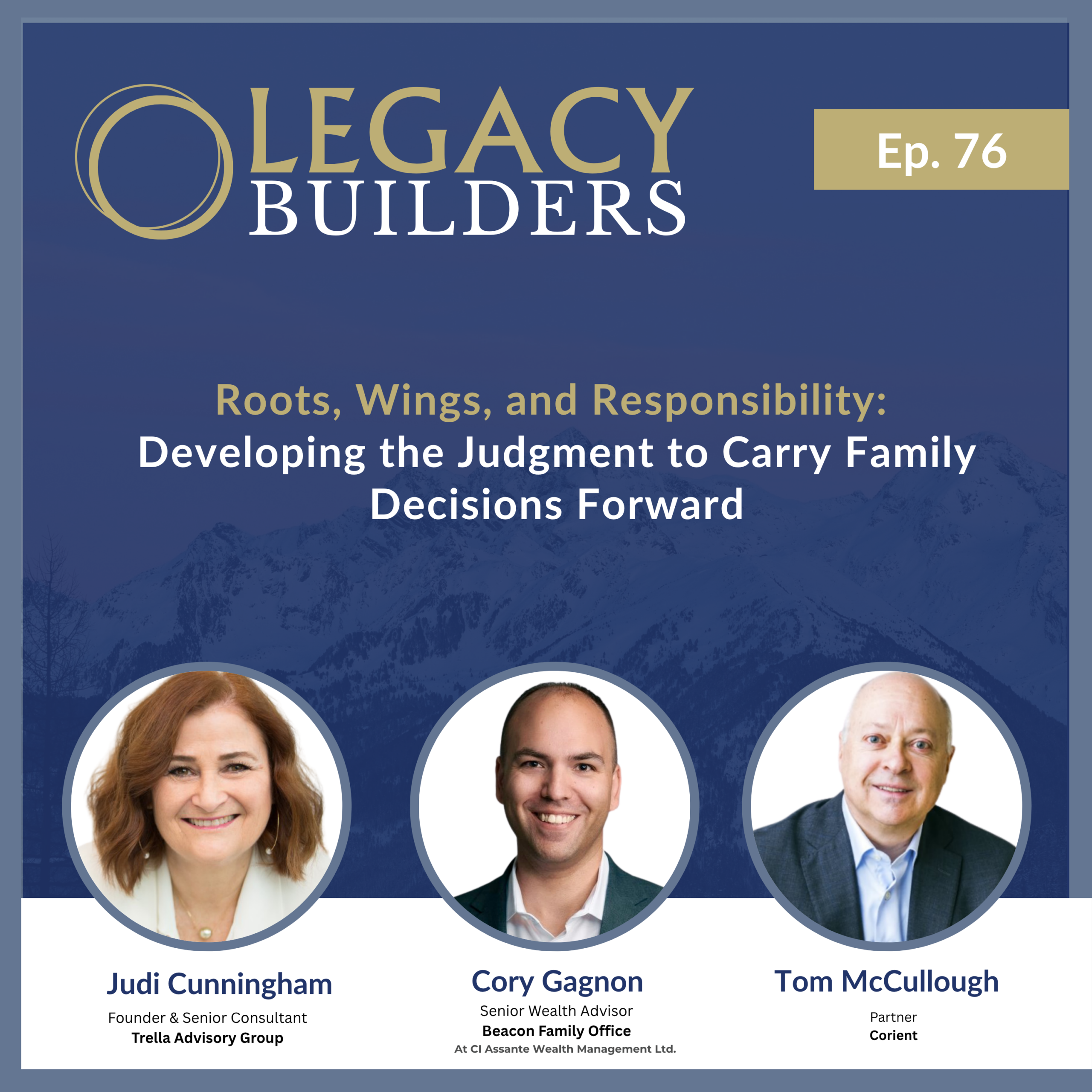
Roots, Wings, and Responsibility: Developing the Judgment to Carry Family Decisions Forward
LISTEN ON YOUR FAVOURITE PLATFORM
In this episode, Cory Gagnon is joined by Judi Cunningham and Tom McCullough for a timely conversation on how families can make better decisions together. From estate plans to ownership transitions, it’s rarely the decisions themselves that hold families back; it’s the buildup around them. Roles are unclear. Assumptions go unspoken. And sometimes, one voice dominates when collaboration is what’s really needed. Judi and Tom share what gets in the way, and more importantly, how families can start moving forward with clarity, confidence, and trust.
Pulling from years of experience in family systems, governance, and family office strategy, they offer practical tools for navigating complexity without losing momentum. Whether it’s building development plans for the next generation, turning good intentions into written agreements, or understanding who actually gets to decide what, this session is packed with insight. If your family is working through a transition or trying to avoid the next standstill, this conversation will help you create more alignment without overcomplicating the process.
About Tom McCullough
Tom McCullough is Partner at Corient and Managing Director at The Ultra High Net-worth Institute, the leading Canadian multi-family office. He has spent over 35 years in the wealth management/family office field.
Tom is a frequent speaker on issues relevant to families of wealth and is the co-author of Wealth of Wisdom: The Top 50 Questions Wealthy Families Ask and Family Wealth Management: 7 Imperatives for Successful Investing in the New World Order. He is an Adjunct Professor and Executive-in-Residence at the University of Toronto’s Rotman School of Management MBA program. He is an Entrepreneur-in-Residence at Western University’s Ivey School of Business and a member of the Editorial Board of the Journal of Wealth Management. He recently received the 2020 Family Wealth Report Awards for ‘Best Individual Contribution to Thought Leadership in the Wealth Management Industry.’
Contact Tom McCullough | Corient
- Website: corient.com
- LinkedIn: Tom McCullough
- Email: tm@northwoodfamilyoffice.com
About Judi Cunningham
Judi Cunningham is the Founder and Senior Consultant at Trella Advisory Group, a consulting firm that works with family enterprises and families of wealth. With a Master’s in Family Systems Counseling and over 25 years of experience, she excels in navigating complex family dynamics and business challenges. Judi’s strategic insight and facilitation skills help families find alignment and address tough decisions. Judi is known for her innovative educational initiatives. She pioneered the Family Enterprise Advisor Program, establishing global standards for professional advisors. In addition to her for-profit work, Judi volunteers her time to support multi-generational family success. She serves as the Chair of the Board for the Purposeful Planning Institute, which helps advisors serve families of wealth and families in business.
Contact Judi Cunningham | Trella Advisory Group
- Website: trella.ca
- LinkedIn: Judi Cunningham
- Twitter: TrellaAdvisoryGroup
- Email: judi.cunningham@trella.ca
- Phone: (604) 360-1516
Contact Cory Gagnon | Beacon Family Office at CI Assante Wealth Management Ltd.
- Website: BeaconFamilyOffice.com
- LinkedIn: Cory Gagnon
- LinkedIn: Beacon Family Office
- Email: beaconfamilyoffice@assante.com
Resources discussed in this episode
We’re bringing together leading experts to tackle some of the most pressing challenges facing family businesses today, from succession planning and governance structures to preparing the next generation for leadership roles. You’ll walk away with actionable strategies and fresh perspectives on building resilient family enterprises.
Welcome to Legacy Builders strategies for building successful family enterprises. Brought to you by Beacon Family Office at CI Assante Wealth Management Limited. I’m your host, Cory Gagnon, Senior Wealth Advisor. On this show, we explore global ideas, concepts, and models that help family enterprises better navigate the complexities of family wealth.
This episode continues our panel-style conversations on Legacy Builders, where we bring together multiple perspectives to explore the decisions that shape family enterprises across generations.
Joining me today are Judi Cunningham, Founder and Senior Consultant at Trella Advisory Group, and Tom McCullough, Partner at Corient and Managing Director at The Ultra High Net-worth Institute. Judi brings more than 20 years of experience helping families navigate ownership, leadership, and exit decisions, while Tom has spent more than 35 years working with families on family office strategy, governance, and wealth continuity.
Together, they help us look more closely at what can get in the way when families are trying to move forward. We explore where decision-making begins to stall, why structure alone does not create alignment, and how families can build greater clarity around roles, expectations, and the way decisions are made.
Whether you are part of a family enterprise, supporting the rising generation, or advising families through moments of transition, this conversation brings decision-making back to the people, relationships, and shared understanding that allow families to move forward together.
Now let’s dive in!
Cory: Welcome, Judi.
Judi: Thank you. Pleasure to be here.
Cory: Welcome, Tom.
Tom: Thanks, Cory. Glad to be here too.
Cory: Jumping to our first question, what gets in the way of making clear decisions in families and how can they regain momentum? Now, when I’m working with families, it’s rarely the decision itself that stalls them. It’s the buildup around it. Roles aren’t defined. Assumptions haven’t been voiced, or there’s a worry that disagreement might cause conflict. I’ve seen families spin for months or even years because of that. And when we slow down and actually name what’s under the surface, that’s when that clarity and momentum can start to return.
So, Judi, when you’re brought in, oftentimes, things have already started to stall. What are some of those early signs that you look for that a family’s avoiding a decision, and how do you help them find their way through?
Judi: Yes, I would love it if families came to us way earlier in their process. Unfortunately, they are already in a state of, sometimes it’s indecision, sometimes it’s a level of challenge, or I don’t really like to use the term conflict. Not all families are in conflict around what they’re doing, but they sometimes have differences around how they see things. And so they don’t often seek help until they’re further down the path, which is unfortunate, but that’s just the nature of it.
I think the other thing that’s really important to understand is that when we’re talking about families, a family is not a thing. A family is a collection of individuals. And so yes, a family has a culture, and a way of thinking and organizing itself, but they are a collection of individuals. And so even when we think about decision making, it’s never like the family doesn’t agree with this particular thing. It’s that the there’s individuals that are in different places on those decision-making continuums.
So you have one person that says, I, I think we should do this and we should move forward. And this is how I think we should move forward. And then you have somebody else that’s saying, well, I don’t think we should move in that way. I think we should try it this way or that way.
And the blanket thing where these things really get stalled and where people tend to avoid is at transition points. And so there, there’s something going on in the family that they’re trying to transition. So whether it’s a business, whether it’s wealth and they’ve sold a business and now they’re trying to figure out how we transition the wealth. And so what generally happens is that people think that’s an estate planning decision. And what they don’t understand is that there’s a component that requires the family to get together and make these decisions. And so even if you have the best estate plan in place, it doesn’t solve for how these families are going to make decisions into the future.
Right before this, I was talking to somebody about a family that the two family members are not moving in the same direction. And one has an idea of how to move forward. And the other one has a different idea of how to move forward. And that is in every single family. So it’s always a struggle to find alignment. In some families they get aligned more easily, but in others it’s harder to find that alignment, but we’re always looking at, I mean, when you’re saying how do we help them through is we’re always looking at where the places that you actually agree, and let’s focus on the agreement and then look, let’s look at where the places that we don’t agree, and then figure out, are we actually closer than we might think? Because I also think that families, family members are closer than they actually think sometimes. So they think that we’re in a disagreement about this and we’re never going to get to agreement. And sometimes I think you’re actually not that far apart.
So I would say that some of the strategies that we use is really working with the individuals in the family to try and help them get clear about where are the places that I’m not willing to budge on, and where are the places that I am willing to, if it’s if it’s not that big of a deal to me, I’ll just move forward on that. So we work with the families, the members individually, and then also collectively as a family.
Cory: Amazing. I love that you say it’s a collection of individuals because, yes, we’re all so different and make up that collective.
Now, Tom, as you see families hitting that standstill, how can the family office team be a part of getting things moving again without pushing too hard?
Tom: Great question. I would say, as a family office, we are involved in really all aspects of a client’s life. So whether it’s financial and investment and tax and estate, or decision-making and next gen preparation. I would say families typically don’t come to us in a crisis. It’s more like they need somebody to help us pull all this together. So we’ve got all these, and we start from we’ve got the luxury, I’ll say, of starting from a clean sheet of paper in some ways, as opposed to having this immediate thing that has to be solved tomorrow where everything blows up. So we’ve had all these past conversations with people about what’s important to each of you individually, what’s important to you as a family. We’ll often have conversations at the beginning in principle, how are we going to make decisions when we are not in agreement on major issues and we want to write some of them down.
So we often have those conversations. It’s really tested when it gets stuck, as Judi’s saying, you know, those things get tested. They probably weren’t robust enough, they’ve got to be strengthened when you get into a real live stuck situation. But we’re big believers in facts, and it’s really interesting how often people say, well, I think it should be this. I think it should be that. And one of the roles that we can play as a family office is we have all the facts. So sometimes just laying out the facts of the discussion helps, because people look at it, they read the facts, or hear the facts, they go, I thought it was this. I thought it was that. And clarifying the facts brings some help, and sometimes some breakthrough. Not all, because as Judi correctly says, these are all individuals, and they’ve got not just the facts, but they’ve got their own opinion of the facts.
But but oftentimes, when there’s tension or standstill, one of our jobs will be to step back using the whole integrated connection of things that we’re involved in, and bring these facts to the table, lay out the situation, and help people sort through, so help people as a group sort through which things, as Judi says, where we’re agreed, where we’re not agreed, and isolate the issues that are real problems.
There’s this concept. I wrote a book called Wealth of Wisdom. The second one is called Top Practices for Wealthy Families and Their Advisors. And there’s a chapter, chapter 48 in that book, by Mimi Ramsey and Stephanie Hardwick, and they talk about expectations versus agreements. And expectations are, well, I think, you know, kids should do this, or kids should do that, or I would expect this of you, but they’re often not stated. And they’re certainly not agreements. It’s what you expect, but it’s not what the other person has agreed to.
So I think that that kind of approach of bringing facts, a deep breath, a second sober thought, laying things out, and I think also the idea of being a neutral party. And you have to work hard at that because often when mom and dad pay you, how are you viewed by others in the family or one particular person pays you? So you have to be very careful that you are trusted as much as possible by everybody so that you can be that neutral person that brings clarity as we’re talking about, to help families regain momentum.
Judi: I would just add, Cory. I think I love what you’re saying, Tom, just around the facts is that one of the things that we find a lot of is people don’t actually understand some of those facts. So if you look in an estate plan and you say, okay, here’s how it’s all structured. And the family often is not privy to what’s in the estate plan of the parents. And so they don’t understand that, you know, I’m a beneficiary of a trust. And I think so many family members think that that gives them voting rights, that they have a say in how things happen. And I’m like, no, that’s not. So, understanding who the trustees are and where the voting control sits.
Because as we know in ownership, there’s two pieces of it. There’s value and control. And I think that those two things get muddled for a lot of family members, and they really believe that they have control once whatever is transitioning to them. Well, if it’s held in trust, they still may not have control depending on the structures.
So I’m a huge believer in helping families, family members, especially in the rising generations, understanding what is happening in the state plan of the leading generations, because if they don’t understand it, they can go off on all kinds of tangents, and then they’re fighting over things that there’s no point fighting over it, because you actually don’t have a say in it. And, now if you want to have a say in it, that’s a whole other conversation. But currently, the way it’s structured, you don’t actually have a say. And this is very confusing for families, I find, and family members.
Tom: And if you’ve got 15 items on a complaint or disagreement, if you can go through those items and get rid of 12 of them because just the facts help you realize, I didn’t. I didn’t realize that that’s not on the table. Then there’s only three left to deal with. Right. That’s a lot easier than 15.
We always talk about getting the clutter off the radar screen.
Judi: Right.
Tom: You know, and help the plane land. If you can get all that clutter off, often it’s hard for people to ignore facts. But if you can put them out there and take those things off the list, you get then a few nuggets that aren’t easy to deal with, but there’s fewer of them.
Judi: Yeah. Yeah. And then we have the balance, sorry, Cory. I know you’re trying to get in.
Cory: It’s great. Though. Great deal.
Judi: So the other thing is, when you’re dealing with human beings, there are no facts. There’s all just perspectives and viewpoints on things and somebody will go, that’s actually what happened. And so there are facts around the quantifiable things. And then there’s all these mushy perspectives around the qualitative elements. And when you blend those two, that’s where this work gets so complicated and complex.
Cory: I love that, Judi, you said exactly what I was going to say. I was thinking perspective is everything, and that is that is bang on.
Okay, second question. How does governance help create clarity and continuity in decision making? So thinking about that decision making continuing, through generations. And I hear a lot of families say we need governance. But when we dig into it, they’re really looking for just that shared understanding, how they’ll make decisions, how roles are defined. That structure matters, but as long as it creates clarity and not bureaucracy.
So, Tom, from your experience, being asked to build out these structures, what types of roles or processes actually help families move forward with clarity?
Tom: Well, I do hate the word governance. It’s sort of popular these days. But if you want to scare anybody off talking to you at a cocktail party, just mention the word governance, and their eyes will blaze over. It could feel bureaucratic. It could feel abstract. It’s even a bit joyless. It conjures up images of red tape and formal charters rather than what you said, Cory, the real intent, which is things like clarity, alignment, accountability, and how we’re going to get along, make decisions, and move things forward. That’s really what it is.
So I often think about it as, you know, how do we make decisions together as opposed to governance. Because people immediately go to, well, should we have a 40 page constitution? And should we do this? And should we do that? And I think a lot of the literature says that’s important these days. But I think families have this crazy notion that they have to have all those things, whereas oftentimes they don’t. It’s a simpler family. Families off without governance, though, often run on personality and history. That works fine until a key person dies, retires, leaves, and then the wheels fall off. And governance is a bit of an antidote to that. It replaces, you know, well, dad always handled this. Well, it’s okay. So just picture dad not being there or mom not being there. How are we going to handle this? And I find that’s a big wake up call for families often, where mom and dad have been the decision makers for a long time. They say, well, it’s fine. I don’t want to get involved. Well, you’re going to have to get involved at some level, at some time when mom and dad are not around to make those kinds of decisions, or grandpa, or whoever the person is.
Getting people around to the idea of “we need a decision process.” But what they really need, I think more than anything, is they need a shared understanding of how they make decisions and who’s going to play what roles and how are we going to kind of make this happen in real time. And we’ve got all sorts of examples of how people do that from, I’ll say relatively simple things. We’re talking about investment policy statements and how that’s a form of governance. You look at your investments and you write down the way that you’re going to manage your investments. And if you’re going to veer from that, which you’re allowed to, you have to change the policy statement. And who has to agree to that? Well, whoever your governance says must agree to it.
We always think about investment policy statement as something you write when you’re sober.
But then when you’re drunk with fear, greed, busyness, or inattention, you know, then you go, I better look back at what I wrote when I was sober. And that’s the point of governance, you know. When things go off the rails or when a decision comes up, here’s how we’ll handle it. And sometimes you don’t even need to go to that. If everybody agrees and there’s good consensus, you don’t need to pull out the, you know, section 7.12 in the constitution. You just agree. But it’s in the tough times where you don’t have agreement that you need that. So I think governance helps a lot with these kinds of situations. And I think it gives people a sense of confidence, and it gives them a sense of stability in one sense, to know that we’ve got sort of a game plan if and when something happens.
So one of the questions then really, the follow on is, well, what should be part of that? How do you create that? And I think, ultimately, what you’re trying to have is some kind of clarity of roles and responsibilities. Who is responsible for this? Who needs to be involved? And then, ultimately, what you’re trying to do is build a level of trust so that all those rules are not necessarily required.
I personally am a big advocate and believer in minutes. We have minutes for the meetings with our clients, our families for all meetings, but certainly in governance type situations, because we all forget or maybe even choose to forget, what we said last time. But back to facts, it’s one of those things we can turn to and say, okay, we did decide this. So that takes one of those clutter things off the radar screen. I mean, people can change their mind, but it’s very helpful.
And, again, I do think, especially in the early days of building governance, that it can be very helpful to have an external party as a facilitator. I think people behave better when there’s somebody from outside there. They don’t have all the same biases that you bring because your sister wronged you when you were seven, which do factor into decisions.
So we’ve got a family who, with our help, built what they call a playbook. And it’s just kind of the rules of the road, and it’s everything from how much are we going to fund kids for houses, how are we going to handle school, how will decisions get made on investment decisions? How will spouses be integrated? So these are just decisions that they’ve made in a sane, sober moment, and bought into it. It took some wrestling on some of them, but they feel this degree of confidence that this set of documents for them, which is not very long. It’s like five pages, four pages. But it gives them a sense of confidence that they can move forward in a clear way.
Cory: So many great examples, Tom. I, I think we could dive into a bunch of them, but, I’ll keep us moving.
Judi, you talked about the beneficial ownership. Do we actually have the decision capability here, or does somebody else have the decision? So how do you help families feel heard even when not everyone has equal authority?
Judi: Well, first of all, I think helping them understand, even understanding where some of the structures and the decisions came from is very helpful. I think working with families, having them understand, if they are being explained, this is the way the estate plan is structured, and this is how things are done. Why do we do it that way? I think that’s a really important thing.
It’s not because they don’t want their viewpoint, but sometimes the senior generation members don’t ask their kids to be involved in decision making because they don’t think about it. They think, look, I created all of this stuff. It’s mine to decide. And then they have advisors around them that are saying, it’s all your stuff. It’s yours to decide. And you know what? All of that is true. So you create it, you, you get to decide what happens with it. But what I always say to the senior generation members is what got you here won’t get you there. So what you’ve been doing has worked to get you where you are today, but it’s not going to work. If what you’re trying to do is create a collaborative group of people, let’s say you have five children. If they don’t learn how to collaborate, if they don’t learn how to make decisions together and all the decisions are sitting up here with one or two people, or with four or five people, the senior generation members, it doesn’t really matter. If the next generation is not brought into the conversation and getting their opinions on things, then they’re never going to get brought along. And I find that the hardest thing is just getting them in the conversation.
The other thing that I find sometimes is, and I think this is just a human dynamic, is that sometimes we don’t want to talk about what we want to do because we don’t want somebody to tell us, I don’t agree with you. And so I’m not even going to say what I want. I’m just going to do what I want to do behind the scenes over here because I don’t want anybody to disagree with me, because I’ve already made up my decision. So I think that the real work is helping families understand the value of why they want to learn how to make collaborative decisions and that process, just getting them to have more people at the table.
The other thing for some families, especially if you’ve got really strong entrepreneurs that are used to, like, it’s a governance of one, it’s one person and they make all the decisions. They go, well, everything’s really fast when you have one person, and now you’re bringing in all these other people, and everybody has an opinion, and everybody thinks you should do it this way or that way or whatever. And it’s so slow and it drives them bonkers. And so they just want to override. And I’m always saying to them, look, if you override, you can do it. You can override what they’re doing because it’s making you nuts, because it’s taking too long. But it’s not going to help serve them as they are trying to learn how to make these decisions together.
And, I couldn’t agree with Tom more around governance. Governance is, separate from the word, they’re, they’re structures, processes, and policies. There’s all these things that Tom talked about, and we want to put them in place. I’m actually less of a believer in the structures. Sometimes the structures are important, but sometimes they actually cause problems. I’m a big believer in documenting everything to Tom’s point. When you document it, when it’s in black and white, you can’t argue, especially when everybody was at the table and then they say, well, I didn’t agree with that. Well, you were actually at the table. You helped create this document. You gave your opinion on these clauses that are in here. You participated in this, or if you didn’t participate in it, it was given to you and you had an opportunity to give feedback on it and you just didn’t do it because either you went fine, I don’t care. But now you’re being asked to live according to one of those policies. And then they’re like, I don’t like this. Okay, well, let’s now talk about it again.
And so I think that documenting is incredibly important, and in a whole bunch of ways around policies, around having minutes, just knowing what the conversations have been, what the decisions have been. We made this decision today. What we all know is decisions are not cast in stone. We can make a decision today and change it tomorrow. But we need to acknowledge that that decision was made. And now if we’re going to change it, why are we changing it? What are the new parameters around changing it? I would say helping family members feeling heard is really navigating some of that, both individually and collectively.
So we work with families as a whole, obviously. And then we also do a lot of work individually. But when we work with individuals, what I’m always trying to say to them is nothing’s going to change until you say this, that you’re saying to me, to your whole family, because that’s where the movement is going to happen. You telling me I’m not going to go. Sometimes people want to tell me or one of our advisors, because they’re hoping that we’re going to go and be their advocate in the system. And we’re going to go and say, well, Cory thinks that we should do that. You guys should do this. And I think that’s a really good idea. And then I’m going to sway them somehow. And so, that’s not how it works. As a consultant, we are listening and we’re helping them find their voice so they can bring their voice into the system and say, this is what I want. This is how I think these things should move forward and be able to listen really carefully to what their siblings, or cousins, or whoever.
Tom: Can I just add two quick points to build on Judi’s comment? One of my favorite articles out there is called When You’ve Made Enough Money to Cause Family Tension. And it’s written by Josh Baron and Rob Lachenauer, and it’s a Harvard Business Review. So if anybody’s interested in it, you can just look it up by those names online. It talks about there being two acts in the play of life. Act one for the entrepreneur is, as Judi said, they did it all themselves. There were people around, but they did it. People look at them and go, you’re so successful, and, yeah, that’s quick, and you move quickly. But in act two, you’re asked to involve others, share decision-making, discuss things. They don’t know how to do that. This is a whole new thing and they don’t like it, as Judi was saying. So, it’s a great article. If you are one of those people yourself, it’s eye-opening, or if you work with those kinds of people. I’ve left a few of those copies of that article on people’s desks in case they run into it. Could that be me? And then, of course, I’m a big believer in, if you’re pointing a finger at somebody, there’s always three pointing back at you. So I was thinking, how could I be that? How might I be that person in some ways? So I’m always trying to learn as well. Anyway, that’s just to build on Judi’s point.
The other thing I was going to say is, sometimes people think there’s only decision making. That’s the only piece of the puzzle, but there’s many other things. There’s observation to learn. There’s participating without a voice, a vote. There’s being informed. There again, back to The Wealth of Wisdom: Top Practices book in chapter 55. Catherine McCarthy has written a piece on a format called RACI, which some of you will know about. But, really, there’s people who are responsible, accountable. So those are the decision makers. C is consulted, and I is informed. We often talk about governance as who gets to decide, but there’s many other roles. And sometimes it’s helpful just to inform people as opposed to not informing them, even if they’re not ready or qualified to make a decision. So we got to keep that in mind as well.
Cory: Love all of that! So I think we actually transitioned into this next question quite well and probably covered a lot of it. So involving that younger generation and those younger family members earlier, how should families do it?
Judi, if we think about this, how do you support what Thomas just just mentioned there, where younger family members, they have that confidence and the skills that they need. What that entrepreneur was used to doing on their own. How do we help those younger family members find their place and develop those skills?
Judi: I think this is one of the big ones. So it’s one thing if they’re making their way through and they’re in an opco, and they’re working in that, they started an entry level, then they work their way up, and they are developing themselves in those ways. But often what we see, especially with bigger families, is that they’re not working in the opco, but they’re needing to be brought along around. How do I become this steward of wealth? How do I become a responsible owner? And so having a really clear development plan for these next generation members is really critical. And there’s a whole bunch of ways that you can do that.
So, for instance, we put together development councils for the rising generation. And so there are general education pieces in there. And when I say education, I’m using that softly. Sometimes it’s people inside the business coming in or businesses. We have one client where they have, I don’t know, six different opcos. And so the different members of different opcos come in and they educate them on different parts of these businesses so that they get a better sense of how those businesses operate, how they think, how they make decisions, what are the headwinds that are facing them, what’s going on in their industry, etcetera.
So there’s that kind of like specific knowledge around the businesses that the family owns. Then there’s all the skill sets around how are they financially literate? And most firms will do some kind of financial literacy for the rising generation. I’m sure you guys have it, Tom. I think it’s a big area and if you’re going to start sitting in board meetings or any kind of ownership meeting and there’s financials there, well, what are you looking at? How do you actually understand it? What are the things that you need to be concerned about? Do you feel free to ask questions?
So there’s a development plan for each of the individuals based on their education, based on their background, their experience, their desires, because I think the other thing is, and this changes over time. So when you are talking to a 22 year old and you say, what do you want in your life? They’ll tell you something that may be things like I want to travel, party, whatever. I have my things that I want to do at 22. When you talk to the same individual at 28 or 35, now they have children, or they’re on the brink of having children. They’re thinking about life differently. And this happens with all of us. And so, what a development plan looks like for a 35 year old, or a 50 year old, or a 22 year old, it’s very different. And so we look at all of those things and we look at, okay, what is this development plan, and how do we help them grow and experience things?
The other thing which Tom said is that, which I think is really great, is we want to think about ways that they can be in the room when things are happening. I’m working with one family and they started bringing in rising generation members into board meetings. And then they realized that that was actually a bit disruptive. And so now we’re putting a plan together on how to do that in a nondisruptive way, because nobody was really communicated about why they were there. They would participate in ways and when they shouldn’t have been participating, because nobody told them what the parameters were. Nobody helped them understand this is your role when you come into this meeting. And so it became kind of problematic. So they’ve stopped it all. And now we’re looking at, can we restart it, but in a very structured way.
And then the other thing is, are there mentors in the system, either in the executive team, in the board meetings, like are there board members, independent board members that are willing to become mentors to the rising generation? And how do they like even things like, you know, how do you run a meeting and how do you chair a meeting? So what we try to do is put these people into roles where they have to do things. They’re not just watching people do things, they’re having to do things. And then we come alongside them to support them. We’re not just throwing them into the fire pit, and they’re like, I don’t know what I’m doing here. That we try to support them along the way.
I think the only other thing that I would say is that the other thing that we try to do is evaluations on these people, get them feedback. So whether it’s a three sixty, if there’s ways from other people that we can get feedback for these members, it is tremendously helpful for them, because we all go through our lives, and without feedback, we don’t really know what we’re doing well, what we’re not doing well, where we could improve. And I know in my own career, feedback has really shaped a lot of how I have moved forward, and it’s been tremendously helpful. So we try to put them in situations where they are getting honest feedback and where they can grow, and we try to play that role with them as well.
Cory: Awesome, that’s great! And, just as you were saying that, Judi, I was thinking, it’s kind of like showing up to the dinner table as a toddler. We have to teach you that you can’t just throw food everywhere and scream. So it’s the same as the boardroom. Just because you’ve learned how to interact in social interactions, doesn’t mean that that’s how society accepts in that situation.
Cory: Yeah, Tom, I think Judi introduced a few things quite well. And how have you seen family offices bring that next generation into the fold without overwhelming them too soon?
Tom: That’s a whole big discussion about when’s the right time to involve kids. We sometimes are so focused on integrating these people that they don’t get to have a normal life. So I think there’s also that keeping that in mind that as much as possible, can they just be normal people? I remember a client telling us that one of his goals is to have kids who were as normal as possible. And we said, well, you have personal security and you only fly private. So it’s going to be tricky for them to feel normal. You’re already set a pretty difficult bar on that sense. But, anyway, that’s a bit of a different question in terms of when you involve them.
But I think a lot of this is, there’s a readiness for responsibility element, but there’s also just a human element of how do you build self-confidence? How do you build some basic skills? I guess people don’t balance checkbooks anymore? How do you have a budget? How do you learn to pay bills? Basic stuff of life. And actually, I remember my kids being frustrated because they couldn’t do their own tax returns. It’s too complicated for them to be involved in their own tax returns. There’s their owners of their beneficiaries of trusts or blah, blah, blah. And they were saying that’s not fair, that all our friends are, well, one, they’re doing their own track returns, and two, they’re getting a refund. And we don’t get a refund. Yes, there’s some good tax stuff happening up here, but at their level, it’s like, wait a sec.
So we’ve actually taken some steps with our, we’re clients of our family office as well, of Northwood Family Office. Our kids get some of those kinds of benefits. But maybe just some little examples of things, you know, a lot of our clients include their next gens in, I’ll say individual giving programs as part of their foundation. So the kids attend the foundation meetings, in some cases have votes, in some cases have their own $5,000 or $75,000 that they can give, with some preparation of work and a proposal and that kind of thing to other organizations. So you’re not just being taught something, you’re actually doing it. And you’ll make some mistakes. As Judi says, you’ll get feedback from others who’ve done it for a long time. You know, taking a course together.
Yes, we have financial education, one of the programs we offer. We encourage parents to come with kids, with adult kids. So eighteen, eighteen plus, typically university age kids. I always find it so funny when we talk about kids because we have one family that talked about, you know, I don’t know if this money is going to really affect the kids. And we were saying to the family, the kids are 60. So the effect on the kids may perhaps have happened already, and I don’t know if that’s the number one worry. So it’s just a reminder to begin the process early.
Another thing that we do is we’ll work with the kids of our clients, and they’ll have a TFSA account or some money that the family has given them. And they have a meeting with their adviser, and we work with them, and we help them decide when they can move out on their own and help between the parents and kids. Are mom and dad going to support you in making this purchase or that purchase, and how do you want to make decisions, you know, prenup decisions, all those kinds of things. And because we’ve got so many touch points with families in the many areas of their lives that we’re involved in, there’s many places we can, one, work with the kids directly, but also counsel mom and dad to let go in some cases. I know it may not be the perfect decision, but this is a great time for you to let go.
Most of us know the expression, the two things you can give your kids, two most important things are roots and wings. And roots is love, security, and self confidence. But wings is freedom to try things and do things and fail, hopefully, on a modest scale. And then, and maybe I’ll just finish with, I’ll just tell you very briefly about my own family, because we’ve just been through this ourselves. Our kids are 32 and 35, and because we didn’t want to disrupt their lives, we’ve not given them sort of full disclosure about our financial situation, but we did about three years ago. So, they were both over 30, and both have partners, houses, jobs, and earned their way into adulthood as some people call it, by just doing adult type things. And, we said, you know, it’s been like this. Mom and dad are here with all the control, and you guys are here. Is there a way, and we don’t know the answer, but is there a way we can move it like this to be partners in some way over the next five or ten years? What would that look like? Let’s talk about that together. And guess what? I did not lead that meeting. I had one of my partners who looks after us lead that meeting. I took off my CEO and advisor hat, and put on my dad, husband, father hat, and participated as an equal.
And so, that’s just one example, but it wasn’t the right time to do that when they were 16 and 17. It was the right time once they’d accomplished other milestones, really just living milestones, maturity milestones, that we thought they were ready. Because at some point, you don’t want to be having that conversation when you’re 85 and may not have all your wits about you, and they’re 65 and have lived most of their lives. At some point, you’ve got to involve them in the process, whether it’s a business, or just inheritors, or managing a cottage, or whatever it is. Anyway, that was our process, and we’ve just been through it. So I’m a real live Petri dish case. It’s always trickier for yourself. Easier to give advice to others than to do it yourself, but in our case, so far, it’s been really productive.
Cory: Love that, Tom. It takes a lot, that vulnerability to say that I’m doing it myself and actually putting in the work. Sometimes it’s easier to be on this side of the table, giving the advice.
And kind of into our next question. We actually covered the fifth question. So I want to skip that one because we’ve done such a good job. But I want to talk about external pressures, external advice. And we’ve talked about building that decision making confidence. But then there’s following our intuition, that internal compass. And, Tom, you’ve laid out that you get to work with families and and start kind of from fresh and and build things out. But how do you navigate when maybe there is some external guidance that has been given, where maybe the families lost their way, and it’s not quite in tune with what matters to them?
Tom: As I said, we have the luxury early on, of one, choosing clients carefully. So we weed out people who, even before we start, who we think might drift to values that we don’t even buy into, or have values that we think we’re not going to be able to support. And so there’s some of that that happens early. We also go through a whole discussion of values and what’s important to them, and we write them down early on in our discovery and onboarding process. So we have a pretty good sense of their values, and sort of test them in conversation, and refer to them often, so they will know that we think a lot about helping them reinforce the things that are important to them.
And, obviously, you know, for them to be a client, we must have at least generally bought into their values. Many people have different sets of values. There’s obviously some outliers that we wouldn’t take that client. So I certainly have, I’d say, virtually never come across a situation where the external advice is from us that we’re trying to convince them to do something. That never happens. We have nothing to sell. So where that does happen, and maybe that was the intent of your question, is if somebody else is trying to pitch them on something, you know, certain kind of insurance policy, a certain kind of offshore taxing, some kind of something that’s a risky investment, something dodgy, whatever it happens to be, then, yes, that is where we come back to governance processes like the investment policy statement, where we said, do we all agree that this fits into a speculative category, for example, as an investment? If it does, okay, well, we’ve allocated 5%. And for that, that’s 5% of the total portfolio, and we’re full on that. So do we want to go through the process of changing that to make it 7% so we can accommodate this? Or is this the reason, you know, second sober thought that we don’t want to do that?
Another component of governance is values. One of the ways, maybe one of the best ways that you can do governance in that sense is, does this fit with our values? And we’ll often say, what’s the reason for doing this? Does this fit with who you want to be?
And then the third one is really this idea of facts that we’ve talked a lot about. People will want to do something that will save a certain amount of money, or supposedly make a certain amount of money. And we often come back and say, let’s see what the facts are. Is that money needed for something else? Is it allocated for something else? If it works out perfectly, will this make any difference to you whatsoever? And what are the costs of doing it?
So I would say that we are often the ones that come back to people when they want to do something that seems iffy, and I would say that’s not very common. Our clients are pretty thoughtful people, that we would bring up these issues I’ve just talked about. Now having said that, if we give advice and people don’t take our advice regularly and head down these paths, you know, as one of my old colleagues says, don’t hire a dog and bark yourself. In other words, if you’ve hired an adviser, and it’s the right one, and you’re not going to take their advice, maybe it’s not the right fit. And I think that can happen from time to time as well. But again, you know, very uncommon.
Cory: I love that, Tom. I say that I’ve got three three qualities that I look for in a client.
Responsible, responsive, and I would enjoy picking up the phone whenever they call. And I think that the responsible component is that.
Judi, thinking about external advice, what if that external advice is, maybe somebody in the system, maybe it’s a married-in, maybe it’s a friend, maybe there’s some sort of influence that the family as a collective is now split because of that influence. How do we keep that dialogue going and prevent it from being divisive?
Judi: These kinds of things happen all the time inside of families where they’ll say, hey, I was talking to my friend and they’re in a family business and they’re doing x. Maybe we should do that. Or, the accountant told me that, you know, we should be doing these three things right now, and this needs to be really urgent, or whatever it is. And so it comes in a whole bunch of different ways, where different pieces are coming into the system. I mean, look, there’s no silver bullet here in terms of how to actually get them to stay focused.
One of the things that we do when we’re facilitating is go, okay, do we need to stop moving forward with what we’re doing now and actually focus on what this new piece of information is? And sometimes we do. Sometimes it’s important. Sometimes in the dialogue, something will come into the system, that either we didn’t know about, or it’s just moved up in the urgency because this is the nature of this work.
When we’re working with families, they start out saying, this is what’s urgent. And then the urgent pieces start to move around. The tricky thing about being a consultant in this space is that you’re having to lead and follow at the same time. We are not a firm that is giving people practical advice on how the estate plan should be structured. This is the way your portfolio should be invested. They’re not quantifiable, practical things. We might give them advice on things like here’s how we would suggest you set up your governance structures. So there are certainly technical things, but we’re not married to one way or another. If a family says we don’t want to move in that direction, we go, okay, fine. We will, we will move with them. It’s not like we say, okay, well, you’re fired then.
If you don’t want to do this, then we’re done with you. That’s not what happens. We try to understand why they’re resistant to whatever something that we might be suggesting. And we’re also really sensitive.
We started this whole conversation talking about governance, and I think it’s really easy to slap governance structures in place in families. And they have no idea what they are. They don’t know why they have them. They don’t understand how to utilize them and how to navigate them. And so I think that really helping them understand, us trying to understand what they’re trying to do and what they’re trying to accomplish, and then helping them navigate it.
So the other thing that I think is not unique to us, but I think it’s part of our core competency, is we are not going in with one style of person, if you will. When we put a team around a family, they have different backgrounds, different skillsets, different ways of approaching grounds, different different ways of approaching similar problems. And so when we are working with clients, we know that one person may really respond well to one person on the team, and another person might respond well to a different person on the team. And so we really use that. We go, look, you need to work with that person. So if there’s one person in the system that’s saying, I disagree with how we need to move forward or whatever it might be. So, anyway, that’s another piece. And I’m just aware that we’re at the top of the hour, and I’m sure you’re wanting to end this. So anyway, I’ll stop.
Cory: Yes. Judi, I love that urgency versus importance. We didn’t think this was important, but it’s very urgent that we deal with it. And, yeah, cocreating those structures with the family, and then helping them live within those structures that they’ve built is important.
I do want to give each of you the opportunity to just give a final thought. Any key takeaways, pieces of advice, or even a reminder that you’d like the audience to carry with after today? I’ll start with you, Judi.
Judi: I would just say do not overdo it from a governance standpoint. Trying to find alignment inside of families can be very nuanced, and structure can help with that, but it is not the panacea. It’s not the thing that’s going to solve it all. And what I find sometimes is people think you’re having trouble getting alignment, so we’ll just put structures in place, then the alignment will just magically happen. That I would say doesn’t necessarily happen. It can help, but it won’t necessarily fix everything.
Cory: No silver bullet. And, Tom, over to you for your last words.
Tom: I’ll just say two things. One is, start with facts and write stuff down, and it just helps. It’s not the answer to everything. I totally agree with Judi about not overdoing it. The governance has become a business in and of itself. It really should be to help families make decisions. The last thing I was going to say is, I was thinking about Judi talking about the different phases of kids, and when you start to include them in different things. And it reminded me of when you were told to go to bed as a kid at 08:00 as a kid, it was a punishment. And now at our age, it’s a reward. So things do change over time.
Judi: They do indeed.
Cory: Awesome, that’s great! Well, thank you both for sharing your time and expertise with us today And, I know that many people will enjoy our recording here today. So thank you both.
Tom: Thanks, Cory.
Judi: Thanks, Cory.
As we hope this discussion demonstrated, clearer family decision-making grows from shared understanding, defined roles, and space for different perspectives to be heard. It also takes time for family members to build confidence in how decisions are made and carried forward together.
Throughout this discussion, Judi and Tom approached decision-making from complementary perspectives across family dynamics, governance, family office strategy, and next-generation development. Their perspectives came together around one clear message: families move forward more effectively when there is clarity around the process, the people involved, and the responsibilities each person carries.
I’d like to thank Judi Cunningham and Tom McCullough for sharing their experience, perspective, and practical guidance with us today.
One of the reasons we created Legacy Builders was to bring together forward-thinking leaders and trusted frameworks that help families and their advisors gain the clarity and confidence to lead with purpose today and for generations to come. Today’s conversation was a great example of that mission in action.
If this discussion raised questions for your family, ownership group, or clients, you’ll find Judi and Tom’s contact information in the show notes.
Thank you for joining us for another episode of Legacy Builders. Take care, and keep building a legacy that lasts.
Disclaimer:
This program was prepared by Cory Gagnon, who is a Senior Wealth Advisor with Beacon Family Office at CI Assante Wealth Management Ltd. This is not an official program of CI Assante Wealth Management Ltd, and the statements and opinions expressed during this podcast are not necessarily those of CI Assante Wealth Management Ltd. This show is intended for general information only and may not apply to all listeners or investors; please obtain professional financial advice or contact us at BeaconFamilyOffice@Assante.com or visit BeaconFamilyOffice.com to discuss your particular circumstances before acting on the information presented.
